Y-hangs
A Y-hang is achieved by rigging both ropes so that each is attached to, and shares the load between, both anchor points. When the ropes are weighted, the load should be evenly distributed between both anchors.
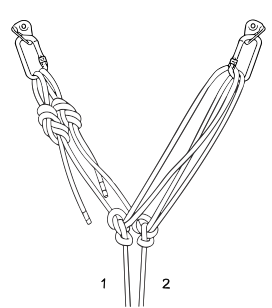
The angle of the Y is everything
Drag the slider to see how the force on each anchor changes with the angle of the Y. The rope colour tracks the IRATA safety bands.
Angle
90°
Per anchor
0.71kN
Multiplier
0.71×
Safe
Numeric reference table
| Angle | Load on each anchor (with 100 kg load) |
|---|---|
| 0° | 50 kg |
| 60° | 57 kg |
| 90° | 71 kg |
| 120° | 100 kg |
| 140° | 146 kg |
| 150° | 193 kg |
| 160° | 288 kg |
| 161° | 303 kg |
| 177° | 1915 kg |
| 178° | 2873 kg |
| 179° | 5747 kg |
The formula
Load at each anchor = (L ÷ 2) ÷ cos(½ A)
Where L is the load and A is the angle of the Y.
Worked example for A = 120° and L = 100 kg:
Anchor Load = (100 ÷ 2) ÷ cos 60° = 50 ÷ 0.5 = 100 kg.
Failure-of-one-anchor swing
Where the anchor points for a Y-hang are located a reasonable distance apart, consider the effects of the failure of one of the anchors (e.g. a swing likely to cause personal injury).