IRATA Training Manual
Mobile training manual for the IRATA rope-access syllabus.
EN · 2026
Table of contents
- 01Introduction
- Importance of training
- IRATA training & certification scheme
- 02About IRATA
- IRATA's mission
- Controlling hazards & reducing risk
- 03Legislation
- Health & Safety at Work etc. Act 1974
- The HSE: Guidance, Codes of Practice & Regulations
- Work at Height Regulations 2005
- LOLER 1998
- PUWER 1998
- COSHH 2002
- Noise at Work 2005
- Manual Handling Regulations 1992
- PPE Regulations 1992
- RIDDOR 1995
- 04Risk Assessments & Method Statements
- Risk assessment — the five-point plan
- Safety method statement
- Permits to work
- 05Equipment
- Harnesses
- Connectors (carabiners & Maillon Rapides)
- Descenders, ascenders & back-up devices
- Ropes — low stretch & dynamic
- Webbing, slings, cow's tails & lanyards
- Helmets
- Equipment strengths, WLL & SWL
- CE marking, certification & EN standards
- Equipment marking & traceability
- Equipment examination
- Eyebolts — types and examination
- IRATA technicians' responsibilities under LOLER
- Storage, quarantine, reporting & disposal
- 06Knots
- Double figure of 8 on the bight (Bunny)
- Figure of 8 on the bight
- Figure of 9 on the bight
- Re-threaded figure of 8
- Bowline
- Alpine butterfly
- Scaffold knot (½ Double Fisherman)
- Double Fisherman
- 07Rigging
- Y-hangs
- Deviations — single & double
- Rope protection — Remove, Avoid, Protect
- Anchors
- Mechanical & chemical anchor bolts
- Ground, dead-weight, beam clamps & roof structures
- 08Rope Access Manoeuvres
- Pre-use checks & safe access to the ropes
- Descending
- Ascending
- Changeovers — ascent to descent & back
- Rope-to-rope transfer
- Passing knots
- Passing deviations & re-anchors
- Pull-through
- Horizontal & vertical aid climbing
- Horizontal & diagonal tensioned lines
- 09Fall Arrest
- Clearance distances & golden rules
- Fall factors
- Suspension syncope / trauma (toxic shock)
- 10Rescue
- Snatch rescue — casualty in descent mode
- Snatch rescue — casualty in ascent mode
- Deviation, re-anchor, transfer & knot rescues
- Large re-anchor & stuck-in-loop rescue
- 11Hauling & Lowering
- Mechanical advantage — 1:1 to 9:1
- Self-locking pulley systems
- 12Glossary
- A – E
- F – L
- M – R
- S – Z
Chapters · 01
Introduction
The importance of training, what this manual is, and the IRATA training, assessment and certification scheme.
Introduction
This manual supplements your Industrial Rope Access Training Course, leading to certification issued by the Industrial Rope Access Trade Association (IRATA).
It is not a substitute for practical training and should be used in conjunction with:
- IRATA Publication: ICOP (International Code of Practice)
- IRATA Publication: TACS (Training, Assessment & Certification Scheme)
Seek guidance from your instructor on which sections of this manual you need to read and understand for your own assessment, and on any sections that are not clearly understood.
Importance of training
Why safety must always be the prime consideration in industrial rope access.
Importance of training
Rope access techniques have been used extensively in industry since the mid-1980s. Before this time the techniques were used in the sports of caving and climbing.
Recreational cavers and climbers accept calculated risks as part of their sport. Decisions are taken to reduce the level of equipment whilst replacing it with increased levels of strength, skill and technique. This lightweight, higher-risk approach is considered to be an enjoyable and positive aspect of caving and climbing as a sport.
The approach taken by the rope access technician is quite different because safety must be the prime consideration in the industrial environment. Nothing is ever left to chance and access is achieved with appropriate equipment and a 100% redundant back-up system.
Persons not using the correct PPE, or attempting to use it without proper and adequate training, are a danger to themselves and others, and are committing an unlawful act that could lead to prosecution.
It is essential that rope access personnel have the appropriate personal protective equipment for the task and have adequate training in all aspects of its correct use, care and maintenance.
During your course you will be taught to use the various access techniques and devices in a safe and controlled manner, always under the direct supervision of your instructor.
IRATA training & certification scheme
Levels 1, 2 and 3 — entry requirements, training, assessment and revalidation.
IRATA training, assessment & certification scheme
IRATA operates a three-level certification scheme. Independent IRATA re-assessments are required every three years at all levels, following a minimum of four days of training.
Level 1 — Rope access technician
- Entry: minimum age 18; no previous experience required; aptitude for working at height.
- Training: minimum 4-day training course.
- Assessment: 1-day independent assessment.
- Validity: 3 years.
Level 2 — Rope access technician
- Entry: minimum 12 months experience as Level 1 and 1000 logged working hours, before expiry date.
- Training: minimum 4-day training course in rope access, rigging and rescue.
- Assessment: 1-day independent assessment.
- Validity: 3 years.
Level 3 — Rope access technician (supervisor)
- Entry: minimum 12 months experience as Level 2 and 1000 logged working hours, before expiry date.
- Training: minimum 4-day training course in advanced rope access techniques.
- First-aid training required.
- Assessment: 1-day independent assessment.
- Validity: 3 years.

What you're assessed on
Each candidate is graded on planning & management, equipment, rigging, rigging for rescue & hauling, rope manoeuvres, climbing techniques, rope rescues and climbing rescues. Results are recorded on the IRATA Assessor Assessment Checklist (Form 060) as:
- P — Pass
- Dis — Minor Discrepancy
- F — Fail
- A — Awareness only (used under direct supervision)
Your instructor will brief you on the specific items required at your level.
Chapters · 02
About IRATA
IRATA's mission, and the moral, economic and legal reasons for maintaining the highest safety standards.
About IRATA
The purpose of IRATA is to ensure that any rope access work done by its members is carried out in a safe and high-quality manner. It was established in the late 1980s following an initiative by leading rope access companies, and is fully supported by the HSE.
IRATA's mission
The aims and activities of the Industrial Rope Access Trade Association.
IRATA's mission
IRATA's mission is:
- To aim for zero errors and accidents in safety and work quality.
- To provide Association representatives able to give informed opinion and advice to external bodies such as CEN and BSI.
- To prepare submissions to government departments on matters such as health and safety and training — e.g. Department of Trade and Industry, Department of Energy, Health & Safety Executive.
- To assist working parties charged with commenting on and discussing existing and draft legislation directives.
- To indicate areas of research and development where initiatives are required to solve problems facing the industry.
- To assist in the provision of appropriate educational training and certification opportunities for personal employment in industrial rope access.
- To provide a forum for the free and informal exchange of experience and opinion.
- To provide guidance on training and certification of personnel involved in industrial rope access and guidance on good working practice.
Controlling hazards & reducing risk
The moral, economic and legal reasons for maintaining high safety standards.
Controlling hazards & reducing risk
There are three reasons why you need to maintain high standards of safety in rope access:
Moral
British society places safety at work high on its moral agenda and will generally react against individuals or companies who place themselves and the public at risk.
Economic
Accidents lead to losses. Companies become bankrupt and individuals lose time off work, or are unable to work again.
Legal
Not complying with the health and safety regulations can lead to criminal prosecution of directors and employees, with a penalty of hefty fines and/or imprisonment.
Rope access is a safe method of working because technicians understand their health and safety duties to themselves, colleagues and members of the public.
Chapters · 03
Legislation
The UK statutory framework that governs work at height: HSE Act, WAHR, MHSW, LOLER, PUWER, COSHH, PPE, Noise, Manual Handling and RIDDOR.
Legislation
This chapter sets out the UK industrial law that governs rope access work — from the overarching Health & Safety at Work etc. Act 1974 down to the specific regulations on lifting equipment, PPE, hazardous substances and accident reporting.
Most of these regulations are enforced by the Health & Safety Executive (HSE). Failure to comply can lead to criminal prosecution.
Health & Safety at Work etc. Act 1974
The general duties of employers, employees and the self-employed.
The Health & Safety at Work etc. Act 1974
This Act sets out the general duties which employers have towards employees and members of the public; and employees have to themselves, their colleagues and the public. Regulations have been passed in recent years to support the Act.
Employers' duties
Employers are under a general duty to ensure, so far as is reasonably practicable, the health, safety and welfare of all their employees at work. This includes:
- The provision and maintenance of plant and systems of work that are safe and without risks to health.
- Making arrangements to ensure safety and the absence of risks to health in connection with the use, handling, storage and transportation of articles and substances.
- The provision of information, instruction, training and supervision as is necessary to ensure the health and safety at work of their employees.
- The maintenance of any place of work under their control, in a condition that is safe and without risks to health, and the provision and maintenance of a safe means of access to, and egress from, the place of work.
- The provision and maintenance of a working environment for employees which is safe, without risks to health, and adequate with regard to facilities and arrangements for their welfare at work.
Employees & self-employed persons' duties
Employees and self-employed persons are under a duty to take reasonable care for the health and safety at work of themselves and any other people who might be affected by their acts or omissions, and to co-operate with their employers and others to enable them to comply with statutory duties and requirements.
The HSE: Guidance, Codes of Practice & Regulations
The three tools the HSE uses to supplement existing arrangements.
The Health & Safety Executive
The Health and Safety Commission (HSC) and its operating arm, the Health and Safety Executive (HSE), have spent the last twenty years modernising the structure of health and safety law.
Three things prompt action
- Changes in technology, industries or risks.
- Evidence of accidents and ill health, plus public concern.
- Receiving European Directives.
The HSE has three main options when action is necessary to supplement existing arrangements.
1. Guidance
Guidance can be specific to the health and safety problems of an industry or of a particular process used in a number of industries. Its purposes are:
- To help people understand what the law says.
- To help people comply with the law.
- To give technical advice.
Following guidance is not compulsory and employers are free to take other action — but if they do follow guidance, they will normally be doing enough to comply with the law.
2. Codes of Practice (COP)
Codes of Practice offer practical examples of good practice. They give advice on how to comply with the law — for example, by providing a guide to what is "reasonably practicable" or what "suitable and sufficient" means in particular circumstances.
3. Regulations
Regulations are law, approved by Parliament and usually made under the Health and Safety at Work etc. Act 1974.
Where risks are so great, or control measures so costly, that it would not be appropriate to leave employers discretion, regulations identify those risks and set out specific action that must be taken. Often these requirements are absolute.
Some regulations apply across all industries (e.g. Manual Handling). Others apply to hazards unique to specific industries (e.g. the offshore oil and gas industry).
Work at Height Regulations 2005
The Avoid-Prevent-Minimise hierarchy and the duties imposed on duty-holders.
Work at Height Regulations
The Work at Height Regulations 2005 address all issues surrounding working at height, in all industries. Following the risk assessment, the hierarchy below should allow you to select the most appropriate methods for work at height.
The overriding principle is to prevent, as far as is reasonably practicable, any person falling a distance likely to cause personal injury.
The hierarchy
- AVOID the risk by not working at height — where it is reasonably practicable to carry out the work safely other than at height, then you should do so.
- PREVENT falls — where avoidance is not reasonably practicable, assess the risks and take measures to allow the work to be done whilst preventing, so far as is reasonably practicable, people or objects falling. This might include carrying out the work from an existing safe place of work, or choosing the correct work equipment.
- MINIMISE the consequences of a fall — where the risk of falling still remains, take steps to minimise the distance and consequences.
- At all stages give COLLECTIVE protective measures (e.g. scaffolding, guardrails, nets, airbags) precedence over personal protective measures (e.g. safety harnesses).
What WAHR requires of you
- Assess the risk to help you decide how to work safely.
- Follow the hierarchy: Avoid, Prevent, Minimise — give Collective measures priority.
- Plan and organise your work properly, taking account of weather conditions and the possibility of emergencies (e.g. worker suspended from a lanyard).
- Ensure those working at height are competent to do so.
- Make use of appropriate work equipment.
- Manage the risks from working on or around fragile surfaces and from falling objects.
- Inspect and maintain the work equipment to be used, and inspect the place where the work will be carried out (including access and egress).
LOLER 1998
Lifting Operations and Lifting Equipment Regulations — the framework that governs rope access kit.
LOLER — Lifting Operations & Lifting Equipment Regulations 1998
LOLER has had a major impact on the rope access industry since its introduction. The term 'Lifting Equipment' means work equipment that lifts, supports or lowers a Load and includes the attachments used for anchoring, fixing or supporting it.
The three principal aims of LOLER
- Lifting operations are properly planned and managed.
- Lifting equipment is used in a safe manner.
- Lifting equipment is thoroughly examined at suitable intervals by a competent person.
Strength
Lifting equipment must have adequate strength for its intended use. Equipment should be selected which meets the standards relevant to its intended use.
Stability
Ensure the lifting equipment has adequate stability and will not collapse or overturn when working. Where lifting equipment is anchored to other work equipment or structures, these must be able to withstand the forces that may be imposed upon them.
Lifting people
Marking of lifting equipment
All lifting equipment should be marked with its Safe Working Load (SWL). Rope access equipment is designed specifically to support the weight of one person, and is automatically rated with a SWL of one person in normal use.
In the event of a rescue this can be increased to two people due to the factor of safety built into the equipment — but this should only be done by specifically trained and competent persons who will avoid generating large dynamic forces.
Because most rope access equipment is subject to particular service conditions (different sized and types of rope with varying levels of wear), it is not generally marked with a SWL. Instead the user information supplied with the product defines the SWL or WLL that can be applied in certain configurations — usually 80kg, 100kg or 150kg depending on the EN Standard it has been tested to.
All components of a rope access system should be identifiable in such a way that they can be traced back to their documentation — declarations of conformity, test certificates and examination reports.
Organisation of lifting operations
- Work should be properly planned by a competent person, adequately supervised, and carried out in a safe manner.
- Work teams should be made up of at least 2 persons, one of whom is deemed competent to supervise.
- An IRATA Level 3 technician should supervise all rope access work.
Planners should take account of visibility and communication between technicians, the work environment (e.g. wind, rain, ice, emissions), and any hazards in the area (e.g. high voltage lines, hot works, abrasion, chemicals).
Thorough & periodic examinations
LOLER requires all lifting equipment to be Thoroughly Examined:
- Before first use (the declaration of conformity normally serves this purpose).
- Upon receiving the item from a third party.
- Every six months, or at intervals specified in an examination scheme drawn up by a competent person, taking account of manufacturer's recommendations and work conditions.
Lifting equipment should also be examined each time exceptional circumstances occur which could jeopardise its safe use.
Periodic Examinations should be carried out additionally where the risk assessment has identified high wear and tear in the period between Thorough Examinations.
If a defect is discovered which could become a danger, the employer should be informed and the lifting equipment quarantined against further use until the defect is rectified.
Records
A certificate of conformity indicating the standard to which the equipment conforms, and any strength requirements, should be made available to the user. All components of the rope access system should be traceable to the certificates of conformity and examination reports. A coded marking system should be used.
- Certificates of conformity should be kept as long as the equipment remains in use.
- Thorough examination reports for the previous two years should be made available for inspection by the authorities.
PUWER 1998
Provision and Use of Work Equipment Regulations — for all work equipment, not just lifting kit.
PUWER — Provision & Use of Work Equipment Regulations 1998
PUWER supports the LOLER regulations. BS 7985 'Code of Practice for the Use of Rope Access Methods for Industrial Purposes' references PUWER for the supply and safe use of all work equipment — both personal suspension equipment and other tools, machinery etc. used on the worksite.
Suitability of work equipment
All work equipment should be constructed or adapted as to be suitable for the purpose for which it is used or provided. The selection of work equipment must have regard to working conditions and any additional risks posed by its use. The equipment must be used only for operations, and under conditions, for which it is suitable.
Maintenance
Employers and others are to ensure that work equipment is maintained in an efficient state, in efficient working order, and in good repair. Where the machinery has a maintenance log, the log must be kept up to date.
Specific risks
The use of equipment is restricted only to competent persons who are given the task of using it. Only suitably competent persons can maintain or repair equipment.
Information, instructions & training
Users and supervisors of equipment must be given adequate health and safety information and, where appropriate, specific written instructions relating to its use. They must also receive adequate safety training, including:
- How to perform pre-use checks (e.g. cables checked, coiled wires unreeled).
- How the equipment may be adapted in use and any risks which may then arise.
- The precautions to be taken.
Prevention of dropping tools
COSHH 2002
Control of Substances Hazardous to Health — and the effect of chemicals on rope access equipment.
COSHH — Control of Substances Hazardous to Health Regulations 2002
Using hazardous substances can put people's health at risk. COSHH requires employers to:
- Assess health risks to technicians and others.
- Act to prevent or control exposure to substances.
- Provide and maintain safety control measures.
- Monitor and record measures and employees' health.
What is a hazardous substance?
Hazardous substances include any material, mixture or compound used or produced at work which is harmful to peoples' health in the form in which it occurs in the workplace. They are found in nearly all workplaces — factories, bridges, oil platforms, office blocks. They can include:
- Substances used directly in work activities — glues, paints, cleaning agents.
- Substances generated during work activities — rock-wool or cement dust, new compounds from mixing chemicals.
- Naturally occurring substances — pigeon droppings, blood, bacteria, grain and dust.
MSDS and CHIP
The Chemicals (Hazard Information and Packaging for Supply) Regulations 2002 (CHIP) require commercial chemicals to be supplied with a Materials Safety Data Sheet (MSDS) which provides information about the types of hazards involved in handling, storing and transporting the material.
It should provide a list of active ingredients as well as information about disposal hazards and any adverse effects on the environment.
This information may not be sufficient to safeguard your health and safety. You should produce a COSHH risk assessment in order to:
- Eliminate the need for the substance if possible.
- Substitute it for a less hazardous material.
- Change the nature of the substance (dilution, pellets instead of powder).
- Look at methods to minimise risk.
Any residual risk can then be lessened by the use of PPE.
Effects on rope access equipment
Noise at Work 2005
Action levels for daily personal noise exposure.
Noise at Work Regulations 2005
The Noise at Work Regulations 2005 require action to be taken to protect employees from hearing damage at each of the following action levels.
| Level | Threshold |
|---|---|
| First Action Level | 80 dB(A) daily or weekly personal noise exposure (LEP,d) |
| Second Action Level | 85 dB(A) daily or weekly personal noise exposure (LEP,d) |
| Peak Action Level | 87 dB(A) daily or weekly personal noise exposure (LEP,d) |
Generally, where there is an excessive noise problem on a site, suitable ear protectors are provided close to where you enter the noisy area.
Manual Handling Regulations 1992
Assessing the risks of moving objects by hand or bodily force.
Manual Handling Operations Regulations 1992
The Manual Handling Operations Regulations 1992 require employers to assess the risks associated with moving objects by hand or bodily force, with the aim of eliminating or minimising the risk of injury or long-term health problems.
All manual handling has to be within the capability of the technician. Manual handling risk assessments can be applied to assess tasks that could pose a risk of acute or chronic injury or condition.
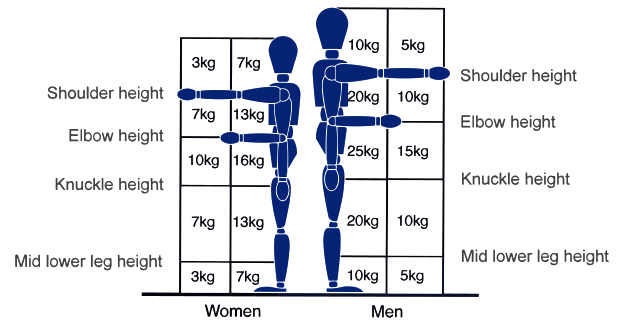
Guideline weights
Approximate maximum loads when handling at various heights:
| Height | Women | Men |
|---|---|---|
| Shoulder | 3 / 7 kg | 5 / 10 kg |
| Elbow | 7 / 13 kg | 10 / 20 kg |
| Knuckle | 10 / 16 kg | 15 / 25 kg |
| Mid-lower-leg | 7 / 13 kg | 10 / 20 kg |
| Floor | 3 / 7 kg | 5 / 10 kg |
The lower figure is for handling at arm's length; the higher figure for handling close to the body.
PPE Regulations 1992
Categories of personal protective equipment and the inspection frequencies that apply.
PPE — Personal Protective Equipment at Work Regulations 1992
The Personal Protective Equipment at Work Regulations 1992 require that:
- Employers provide suitable and sufficient PPE when a risk to health and safety cannot be eliminated or minimised in some other way.
- Employers supply training and information about the hazards and how to use the PPE. They also have to ensure the PPE is being used (e.g. supervision, safety audits).
- PPE is inspected, maintained and stored correctly.
- Employees use the PPE provided, do not interfere with it, and report any defects or deficiencies.
Categories of PPE
| Category | Level | Examples |
|---|---|---|
| Category I | Simple | Gardening gloves, non-specialist coveralls |
| Category II | Intermediate | Industrial safety helmets, protective footwear |
| Category III | Complex | For protection against mortal danger |
Most rope-access suspension equipment falls into Category III and must undergo independent type testing, usually to European Performance (EN) standards.
The equipment must be supplied with appropriate technical and user instructions and must be manufactured under an independently verified quality system (e.g. ISO 9000), or be subject to periodic independent batch testing.
Inspection frequencies
The PPE Regulations require components to be examined at least every twelve months.
HSE Specialist Inspector Report No. 59 recommends that, for textile items, the frequency should be increased:
- Every six months as a baseline.
- Every three months or more frequently for "arduous environments" if the risk assessment shows special hazards.
Why this matters
IRATA's accident statistics show that the majority of reported accidents have been minor and have involved operatives not wearing appropriate PPE — in particular suitable gloves and eye protection.
Operatives are encouraged to wear the appropriate PPE for the full duration of the work activity creating the hazard.
RIDDOR 1995
When and how to report accidents, diseases and dangerous occurrences.
RIDDOR — Reporting of Injuries, Diseases & Dangerous Occurrences Regulations 1995
Reporting specified injuries, diseases and dangerous occurrences is a legal requirement under RIDDOR.
When you must notify immediately
If there is an accident connected with work and:
- An employee or self-employed person is killed or suffers a major injury (including as a result of physical violence), or
- A member of the public is killed or taken to hospital;
…you must notify your company-nominated person immediately (e.g. by telephone) so they can notify the enforcing authority without delay.
What to record
You will need to record and provide details about:
- The work situation.
- The injured parties.
- The accident itself.
A completed accident report form F 2508 must follow the initial notification within ten days.
Over-three-day and near-miss reporting
In addition, any accident where the time lost by the injured person is over 3 days, or any dangerous occurrence seen, should also be reported to your company-nominated person.
Near misses should also be reported to your employer to assist in achieving the aim of continuous improvement of working methods.
Any Principal Contractor governing your site will also have to be informed.
Chapters · 04
Risk Assessments & Method Statements
Identifying hazards, evaluating risks, recording findings, writing method statements and operating permit-to-work systems.
Risk assessments & method statements
The Management of Health and Safety at Work Regulations 1999 (MHSW) require employers to:
- Produce risk assessments and method statements.
- Take measures to eliminate or reduce risks to your health and safety.
- Appoint competent people.
- Provide you with the appropriate access system, information, instruction and training.
As an employee (or contracted self-employed person) you are required to comply with any health and safety training and instructions provided, inform your employer of any shortcomings in that provision, and report any dangerous situations you find developing on site.
Risk assessment — the five-point plan
How to identify hazards, evaluate risk, apply controls and record your findings.
Risk assessment
A risk assessment is a careful, systematic examination of the hazards in your place of work that could cause harm to people or damage plant or property. It is to be done before the work takes place and before the work and access equipment is selected.
- A HAZARD is something that has the potential to cause harm to any person, property or animal.
- A RISK is the likelihood of that harm actually occurring.
When carrying out a risk assessment, identify the significant hazards, evaluate the level of associated risk and indicate whether existing precautions are suitable to eliminate or minimise it. Any judgement of the risk should take account of the total number of persons who could be harmed and the severity of that harm.
The five-point plan
1. Identify hazards in the workplace
- Consider the area in which the rope access team is expected to operate and identify any hazards that could reasonably be expected to cause harm to your team members.
- Look at how anything you do may create a hazard for others. Prioritise hazards that could result in major harm or affect several people.
- Consider what effects other people may have on your team's safety.
2. Identify who could be harmed and how
Identify which team members and any others who are at risk from each hazard.
3. Evaluate the risks and decide whether precautions are adequate
One method of evaluating risk uses the formula:
RISK = Frequency × Severity
Frequency of an accident occurring has the values:
- Highly improbable
- Remotely possible but known to occur
- Infrequent
- Occasional
- Frequent and regular
Severity of the consequences has the values:
- Minor injury, no time off
- Injuries resulting in up to 3 days off work
- Injury resulting in more than 3 days off work
- Major disabling injury (loss of limb, eye etc.)
- Fatality
Multiplying the numbers together produces a risk rating:
| Risk rating | Score |
|---|---|
| Critical | 15–25 |
| Significant | 8–12 |
| Minor | 1–6 |
Hierarchy of control measures
If further precautions are necessary, apply the following hierarchy:
- Remove the hazard completely.
- Try a less hazardous material or option.
- Prevent access to the hazard.
- Organise work to reduce exposure to the hazard.
- Increase the level of information, training and supervision.
- Issue PPE and provide welfare facilities (e.g. washing facilities).
4. Record your findings and inform team members & others
Write down the findings and state how you will eliminate the hazard or control it down to an acceptable level. Communicate to all team members.
They must understand and comply with the contents of the risk assessment and the measures put in place to reduce the level of risk. If other people are in or around your team's worksite, inform them about any risks your work could cause them and what precautions are being taken.
A risk assessment should include:
- A statement of the significant hazards identified.
- The control measures in place and the extent to which they control the risks, plus the options and methods available for workmate rescue (cross-referenced to other documents).
- The persons exposed to the risks.
Keep the risk assessment for future reference.
5. Review and revise
Review your risk assessment at regular intervals and revise it when the situation changes:
- Hazards may change in the same environment over time.
- New equipment, procedures or materials cause new hazards.
- Changing working environments may introduce significant new hazards.
- Young or inexperienced workers joining the team may require further actions.
Safety method statement
The contents and uses of a safety method statement.
Safety method statement
A Safety Method Statement is prepared from the results of the Risk Assessment. It states the sequence of events necessary for the safe execution of the task.
It should be reasonably detailed, setting out the general principles and working procedures for each part of the task. The Safety Method Statement must be shown to, and fully understood by, all members of the team, and made freely available to them for the duration of the work.
Upon completion the Method Statement should be filed away with the Risk Assessment.
Contents of a Safety Method Statement
- Introduction, originator and date.
- Copy of the relevant Risk Assessment.
- Detailed sequence of events, including hazard identification and risk control measures.
- Scope of works.
- Details of all personnel — qualifications, levels of competency, training requirements and team structure. Names of the people responsible for co-ordinating and controlling safety arrangements.
- Special equipment, plant and machinery requirements (including certification where applicable).
- Arrangements for safeguarding personnel and third parties, including the general public; exclusion of third parties from the work area; details of areas outside the site boundaries that may need control during critical aspects of work.
- Emergency considerations such as rescue, evacuation and fire procedures.
- Locations and means of fixing the stability of any lifting equipment to be used.
- Details of PPE and other risk control measures to be used.
- Communications.
- Welfare arrangements.
- Permits to Work / isolation of services.
- Arrangements for temporary services required (e.g. toilets, electricity).
- Arrangements for the control of site transport.
- Any environmental limitations that may apply (wind speed, rain, temperature).
- Arrangements for the disposal of waste.
- How hazardous substances will be controlled (COSHH).
Permits to work
When a permit-to-work system applies and how it must be observed.
Permits to work
Where the environment you are to enter contains hazards such as:
- Live electrical conductors
- Hot metal ducts or vents for steam and gases
- Entering into a confined space
…a Permit to Work system may be in operation. This will generally be obtained from the local issuing authority to ensure that such hazards are effectively isolated before work commences.
Chapters · 05
Equipment
The PPE and rope-access hardware that makes up an industrial rope-access kit — selection, standards, marking, inspection and storage.
Equipment
Every IRATA technician is responsible for inspecting their own equipment before each use. This chapter walks through the items in a typical rope access kit — harnesses, connectors, descenders, ascenders, back-up devices, ropes, webbing, lanyards and helmets — and the standards, inspection criteria and service intervals required by the regulations and manufacturers.
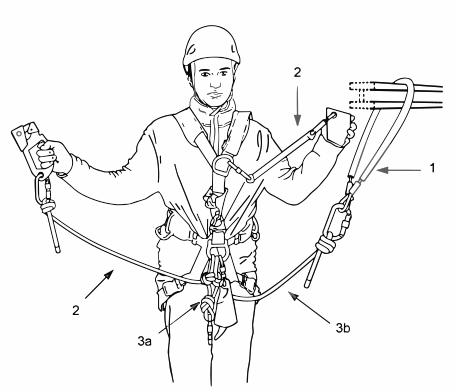
A typical personal set-up
- Wire anchor strop / textile sling, or a secondary back-up "duck" device.
- Absorbica L57 and ASAP / ASAP LOCK.
- 1 m dynamic EN 892 cow's tail × 2.
- Isolated bull-nose from a 4 m continuous EN 892 dynamic rope.
- Scaffold/Barrel to connectors.
Harnesses
Choosing the right harness — sit, full-body and combination — and the EN standards that apply.
Harnesses
Suitable harnesses should be chosen for the task and be of a design that will support the user in the correct position. The harness should be comfortable, allowing adequate movement of the user and the unhindered operation of other devices within the system.
Standards
Harnesses should conform to the relevant standards for their particular application.
- Industrial sit harnesses are designed for Work Suspension (though they may be used for Work Restraint also) and must conform to EN 813. Some satisfy EN 813 and also conform to the work-positioning standard EN 358.
- Fall arrest situations require a full-body harness conforming to EN 361.
Some 'combination' sit harnesses also conform to the requirements of an EN 361 full-body harness, making them a useful dual-purpose harness. Other sit harnesses can be adapted by adding the correct chest harness and a special EN 361 attachment to connect the two.
Connectors (carabiners & Maillon Rapides)
Double-closure connectors, loading along the spine and the EN standards that apply.
Connectors
All connectors used in rope access should be of the double-closure type (e.g. screw-gate or screw-link), as these provide the required level of security from accidental detachment.
Where arboriculture (tree surgery) is carried out, connectors should be of the 'triple-closure' variety, in accordance with the arboriculture Code of Practice.
Steel connectors should be chosen when making attachments to other metal anchors — for example, cables, eyebolts and hangers.
Choosing the right shape & size
The connector should be of such a design and size that it is able to rotate freely on the anchor without hindrance, and without loosening the anchor or putting incorrect loading on the connector.
To avoid loading against the gate, it may be more appropriate to use a carabiner with a captive eye to maintain a lanyard or component in the intended position.
Suitably shaped 'Maillon Rapides' may be more appropriate where permanent or semi-permanent attachments are required, or where multi-directional loading may occur.
Standards
- Carabiner-type connectors: conform to EN 362. The standard requires a Minimum Breaking Load (MBL) of 15 kN, however BS 7985 suggests an MBL of 25 kN.
- 'Maillon Rapide' type connectors: conform to EN 12275 Q or EN 362.
Descenders, ascenders & back-up devices
The three core moving-parts of any rope access system, and the standards that apply to each.
Descenders, ascenders & back-up devices
Descenders
Descenders are devices which attach the operative to the working rope and allow a controlled descent. They must give the user total control over the descending speed and not cause undue shock loading to the rope during braking.
The descender should be of a type that will:
- Stop the descent if control is lost by the operative.
- Cannot be accidentally detached from the rope once threaded.
Descender devices used in the rope access industry should conform to one of:
- EN 12841 Type C, or
- EN 341 A — the standard for descenders used in rescue systems.
Ascenders
Ascenders are attached to and used to climb the working rope. They should be of a type that:
- Cannot be accidentally detached from the rope once engaged.
- Causes the minimum amount of damage to the rope when in use.
Standards for rope adjustment devices are EN 12841 Type B or EN 567.
Back-up devices
These devices are attached to the safety rope and used in addition to any other equipment engaged on the working rope. Should the operator lose control of a descent/ascent, or the working rope fail, the back-up device should:
- Lock onto the safety rope.
- Help to absorb any shock loading generated without causing significant damage to the safety rope.
The Petzl ASAP fall arrest device meets the requirements of both EN 12841 Type A and EN 353-2 — these being the standards for rope access back-up devices and mobile fall arrestors respectively.
Ropes — low stretch & dynamic
Kernmantel construction, EN 1891 A vs EN 892, and the fall factors each rope is designed to handle.
Ropes
Polyamide or polyester ropes of a kernmantel construction are normally considered suitable for rope access applications — constructed with a load-bearing core (kern) and an outer protective sheath (mantel) that provides resistance to both wear and the ingress of dirt and grit.
Low-stretch ropes (EN 1891 A)
Low-stretch ropes conforming to EN 1891 A (with a min. 10 mm Ø) should be used for general rigging. Testing requires:
- Minimum Breaking Load (MBL): 2200 kg.
- Maximum elongation does not exceed 5% (measured between a 50 kg pre-load and a 150 kg load).
Type A low-stretch ropes are also subjected to a series of Fall Factor 1 tests with a 100 kg load, generally breaking after in excess of 10 FF1 falls.
Static ropes — a note
There are currently discussions amongst European Standards Committees about introducing a Static Rope (no stretch) for use in certain situations where the stretch in a standard Low Stretch rope (e.g. on a tall structure) could allow a considerable fall should the main working rope fail. A suitable shock-absorbing element would need to be included.
Dynamic ropes (EN 892)
Dynamic ropes conforming to EN 892 (UIAA 1) Full Rope, with a min. 11 mm Ø, will stretch up to 8% when an 80 kg load is applied, depending on the manufacturer. In a shock-loading situation they can stretch in excess of 50%.
Instead of FF1, dynamic rope is subjected to FF1.78 falls. They generally break after being subjected to in excess of 12 FF1.78 falls.
When choosing the type of rope for a particular application, the need for energy absorption should be balanced against the need to avoid excessive elongation or retraction of the rope.
Webbing, slings, cow's tails & lanyards
Wire and textile slings, cow's tails and energy-absorbing lanyards — choosing and using.
Webbing, slings, cow's tails & lanyards
Wire rope slings
Where there is a risk of abrasion at anchorage points, wire rope slings should be chosen over textile webbing slings. Slings can be manufactured to any length but would generally have a min. Ø of 7 mm.
Wire rope slings should conform to EN 795 B or have a SWL of 500 kg (Factor of Safety 5:1).
Webbing
Webbing-based equipment — slings, harnesses and lanyards — should be chosen so that any damage (through abrasion, cutting, excessive loading, heat, UV etc.) will become immediately visible before significant loss in strength occurs. Structural stitching is of a contrasting colour to that of the webbing to aid inspection.
Anchor slings made from textiles should:
- Have sewn joints.
- Have a minimum rated static strength of 22 kN.
Slings should conform to EN 566, EN 795 B or BS EN 1492-2, and lanyards to EN 354.
Cow's tails
Individually marked cow's tails connect the operative's harness to the safety or working rope (via the appropriate knots and attachment points). They should be able to withstand any dynamic forces they may be subjected to — including those that may occur as a result of a failure within the suspension system.
Generally this requires them to be made from dynamic rope conforming to EN 892 (UIAA 1) Full Rope, min. 11 mm Ø.
The length of the cow's tail should be kept as short as possible and limited to the limit of the operative's reach when under tension.
How long can a cow's tail be?
If the longest cow's tail were 0.6 m in length, with a maximum Fall Factor of FF1 and no shock absorption allowed for, the maximum impact force generated with a 100 kg mass would be 6 kN (600 kg).
Energy-absorbing lanyards
Energy-absorbing lanyards are used to connect an operative's fall arrest harness to a suitable attachment point on the structure. In the event of a fall the lanyard:
- Limits the fall height.
- Reduces impact forces on both the operative and the structure to below 6 kN.
The lanyard's webbing or rope construction should have a minimum rated static strength of 22 kN. The longest length available is 2 m; however lanyards should be chosen which reduce the potential fall distance to an absolute minimum.
Single vs double lanyards
- Single energy-absorbing lanyards protect a worker while entering a small hazardous area via a pre-installed safety harness eyebolt or temporary anchor strop. Also for connecting to a permanent fall arrest system such as a Latchway continuous wire system.
- Double energy-absorbing lanyards are required where progress around a structure is needed — ensuring continual attachment while progressing.
Helmets
Side-impact protection, chin straps and the EN standards that apply.
Helmets
The helmet should provide resistance to side impacts as well as from above. It should have a fully adjustable head cradle and chinstrap for comfort and to prevent accidental loss in the event of a fall.
Standards
Some models conform to:
- EN 397 (industrial) in respect of the shell, and
- EN 12492 (mountaineering) in respect of the 5 kN chinstrap.
Practical considerations
- Helmets without a peak are beneficial when working in a vertical environment — vision is not obscured whilst looking upwards.
- It is an advantage if the helmet allows for the installation of ear defenders and protective face shields.
- Helmets should always be used with the chin strap fastened.
Equipment strengths, WLL & SWL
Minimum Breaking Loads for the kit you'll see every day, and the difference between WLL and SWL.
Equipment strengths
Breaking strengths may vary depending on particular product specifications from different manufacturers. The following items show the Minimum Breaking Loads (MBL) allowable for each Equipment Standard.
Standard MBLs
| Equipment | MBL |
|---|---|
| EN 1891 A Low-stretch kernmantel rope, 10.5 mm Ø | 22 kN (2200 kg) |
| EN 362 Steel screwgate carabiner, 10 mm | 15 kN (1500 kg) |
| EN 12275 Q / EN 362 Maillon Rapide, 10 mm | 25 kN (2500 kg) |
| EN 566 Round webbing sling, 18 mm | 22 kN (2200 kg) |
| BS EN 1492-2 Choked webbing roundsling (WLL 1000 kg) | 56 kN (5600 kg) |
| EN 12278 Swing-side pulley | 15 kN (1500 kg) |
Devices in conjunction with rope (10.5 mm Ø Low Stretch, new)
| Device | Behaviour |
|---|---|
| Descender (e.g. PETZL ID) | Begins to slip at loads circa 6 kN (450 kg). WLL = 150 kg. |
| Ascender | Generally begins to damage the rope at loads circa 6 kN (600 kg). This figure can reduce to as little as 4.5 kN (450 kg) due to age and wear. During EN 567 testing, an ascender should hold a 400 kg load for 3 minutes. |
Working Load Limit (WLL)
The maximum load (as determined by the manufacturer) that an item of lifting equipment is designed to raise, lower or suspend.
Safe Working Load (SWL)
The maximum load (as determined by a competent person) which an item of lifting equipment may raise, lower or suspend under particular service conditions. The SWL can be lower than the WLL.
Factors of Safety in rope access
As a general rule:
- Wire slings, carabiners and Maillon Rapide connectors: SWL = 1/5 of MBL → FoS 5:1.
- Textile items (EN 566 / EN 795 B webbing slings, lanyards, ropes): WLL = 1/10 of MBL → FoS 10:1.
- Lifting slings (BS EN 1492-2): quoted WLL has FoS 7:1 (WLL 1000 kg = MBL 7000 kg).
- Items without a clear BL (ascenders, descenders): SWL = 1 person in normal use; 2 persons in a rescue.
CE marking, certification & EN standards
What CE marking actually means, and a reference list of the European standards that apply.
CE marking & certification
CE marking
All Personal Protective Equipment must be CE marked. For Category III PPE, CE marking indicates that the product has been independently type tested and meets the basic requirements of the Personal Protective Equipment at Work Regulations 1992.
Certification requirements
A Certificate of Conformity should be obtained for the product, stating that it meets the requirements and conforms to any standard it claims to meet.
The PPE Regulations require:
- The product must undergo independent type testing to a particular standard.
- The manufacturer must install a quality management standard such as ISO 9000, or
- The manufacturer must subject the product to regular batch testing at an approved test house.
Key EN / BS standards for rope access
Some standards are under revision — check BSI for the most current revisions.
| Standard | Subject |
|---|---|
| EN 166 | Personal eye protection — specifications |
| EN 341 | Descender devices |
| EN 352 | Hearing protectors |
| EN 353-1 / 2 | Guided fall arresters (rigid / flexible anchorage line) |
| EN 354 | Lanyards |
| EN 355 | Energy absorbers |
| EN 358 | Work-positioning systems |
| EN 360 | Retractable fall arresters |
| EN 361 | Full-body harnesses |
| EN 362 | Connectors |
| EN 363 | Fall arrest systems |
| EN 364 | Test methods |
| EN 365 | General requirements for instructions and marking |
| EN 397 | Industrial safety helmets |
| EN 564 | Mountaineering accessory cord |
| EN 565 | Mountaineering tape |
| EN 566 | Mountaineering slings |
| EN 567 | Mountaineering rope clamps (ascenders) |
| EN 568 / 569 | Ice anchors / pitons |
| EN 696 / 701 | Polyamide / general fibre ropes |
| EN 795 | Anchor devices |
| EN 813 | Sit harnesses |
| EN 892 | Dynamic mountaineering ropes |
| EN 958 | Via-ferrata energy absorbers |
| EN 959 | Rock anchors |
| BS EN 1492-2 | Textile roundslings |
| EN 1496 / 1497 / 1498 | Rescue lifting devices / harnesses / loops |
| EN 1891 | Low-stretch kernmantel ropes |
| BS 7883 | Code of practice for EN 795 anchors (design, install, use, maintain) |
| BS 7985 | Code of Practice for rope access methods for industrial purposes |
| BS 8437 | Personal fall protection systems and equipment for the workplace |
| BS 8454 | Delivery of training and education for work at height and rescue |
| EN 12275 | Mountaineering connectors |
| EN 12277 | Mountaineering harnesses |
| EN 12278 | Mountaineering pulleys |
| EN 12492 | Mountaineering helmets |
| EN 12841 | Rope adjustment devices for work positioning |
| EN 45014 | Suppliers' declaration of conformity |
Equipment marking & traceability
Why and how to mark each item so it can be traced back to its documentation.
Equipment marking
Equipment should be indelibly marked so that it may be individually traced to all relevant certification. The marking allows the origin, standard, inspection history and history of use to be established at any given time for any given single item.
Suggested serial code scheme
Use a serial code comprising letters and numbers to uniquely identify each individual item. (All Petzl equipment manufactured from 2006 is marked with both batch and individual serial numbers in the factory.)
- Two letters identify the type of item — e.g. Chest Ascender: CA.
- A number identifies the item uniquely — e.g. 001.
The serial code for this particular item would then be CA 001.
For dynamic rope use DY; for low stretch rope use LS. Always mark each rope with its length in metres — at both ends.
How to mark each item
| Item | How to mark |
|---|---|
| Helmet | Mark the serial code on the inside with an indelible pen that will not affect the integrity of the shell. |
| Metal items | Engrave lightly with the serial code in an area clearly visible and in a manner that will not affect function or load-bearing properties. |
| Webbing | Mark the serial code on the information tag supplied with the item. |
| Harness | Mark the serial code on the information tag supplied with the harness — or engrave it on the metal attachment point if it has one. |
| Rope | Wrap suitable marking tape around the circumference at both ends. Write the details with an indelible pen. Cover the tape with clear heat-shrink sleeving. |
Equipment examination
Pre-use, periodic and thorough examinations — what to look for in textiles, metal and helmets.
Equipment examination
Equipment examinations play a central role in the IRATA scheme of work. They fall into three categories:
- Pre-Use Check — before each use and continuously during use.
- Periodic Examination.
- Thorough Examination.
All inspections of PPE must be carried out by personnel who are trained and competent to do so. Familiarity with all equipment is essential if deviations from the norm are to be detected.
Manufacturer's lifespan recommendations
Strictly follow manufacturer recommendations on obsolescence. In certain circumstances, the maximum service life could be as little as a single use.
- Petzl metal items have an indefinite lifetime. Removal from service is the responsibility of the competent person carrying out the examination.
- Petzl textile items have a maximum life of 10 years. Removal from service is the responsibility of the competent person carrying out the examination.
1. Textile equipment
Rope and webbing should be given a visual and tactile inspection, both before being placed into storage and before being issued back into service.
For kernmantel rope, a tactile inspection should be conducted by physically running the rope through the hands and feeling for any deformities to both the inner core and outer sheath, whilst visually checking the sheath for damage etc.
Webbing equipment should be inspected for:
- Cuts, nicks, tears.
- Abrasion.
- Broken stitches.
- Chemical contamination.
- Distortion of the weave pattern (indicating that the product has been subjected to undue loading).
Common causes of damage
- Abrasion is the most common cause of strength loss. Often the internal cause (dirt and grit) is the most-overlooked.
- Mechanical damage (e.g. crushing from a falling rock) is proportional to severity.
- Overloading and shock loading weaken ropes and webbing — items subjected to a high load should be scrapped immediately, in such a way that they cannot be returned into service.
- Chemical damage is often difficult to detect until disintegration begins — look for white powdery residues on the surface or a notable change in texture.
- Heat damage — burnt or glazed appearance indicates exposure to high temperatures.
Cleaning & maintenance
- Wash in clean water at a maximum of 40 °C.
- Use pure soap flakes or a mild detergent (pH 5.5–8.5).
- Rinse thoroughly. Bag textiles before machine washing to protect against mechanical damage. Do not use a high-pressure hose.
- Dry naturally in a well-aired room away from direct heat or sunlight.
- Textiles in contact with rust should be washed. Permanent rust marks → scrap.
2. Metal equipment
Inspect carabiners, Maillon Rapides, ascenders, descenders and harness buckles to ensure mechanical function is not impaired:
- Springs, hinges and threads work smoothly.
- Bolts and rivets are tight.
- No signs of deformation, wear, cracks or other deviations from the norm.
Equipment should be kept clean and dry. Lubricate moving parts (excluding those that may come into contact with textiles) with silicon-based lubricants.
Cleaning & maintenance
- Submerge in clean hot water (max. 100 °C) using a detergent or soap.
- Rinse thoroughly.
- An abrasive pad or scrubbing brush may assist — non-metallic (e.g. nylon).
3. Helmets
Check both inside and outside the shell for wear, cracks, burns, deformation and traces of chemical substances. Check the cradle for sound fixing, tears and loose stitching. Verify all adjustable parts are fully operational without slippage and not damaged or worn.
Cleaning & maintenance
- Wash with clean water at maximum 30 °C.
- Do not use a high-pressure hose.
- Use a soap or powder suitable for delicate fabrics to wash the straps.
- Dry in a cool, dark, well-ventilated place.
- Remove adhesive (e.g. stickers) with methylated spirits.
Eyebolts — types and examination
Eyebolts for rope access, lifting loads and fall arrest — and the different examination regimes that apply.
Eyebolts
The British Standard 'Code of Practice for the Use of Rope Access Methods for Industrial Purposes' (BS 7985) states that all eye-bolt anchors used for the purpose of rope access should comply with EN 795.
1. Eyebolts for rope access
LOLER Regulation 9 requires such eyebolts to be thoroughly examined by a competent person at least every 6 months (or at frequencies determined in a written examination scheme drawn up by a competent person).
The competent person has the responsibility to determine whether the thorough examination should include testing. In addition, eyebolts should be inspected before each occasion of use.
2. Eyebolts for lifting loads other than people
| Usage | Classification | Examination |
|---|---|---|
| Removable threaded eyebolt screwed into a load as an attachment for lifting slings | Accessory for lifting | Thoroughly examined every 6 months (LOLER Reg 9). |
| Eyebolt or pad eye used as an anchor for supporting lifting equipment (e.g. a winch) | Lifting equipment | Thoroughly examined at least every 12 months under LOLER. |
| Pad eye (or link) permanently fastened to a load to connect lifting slings | Part of the load | Maintained safe (PUWER Reg 5), of adequate strength (LOLER Reg 4), pre-use check (LOLER Reg 8). |
3. Eyebolts for fall arrest
An eyebolt which acts as an anchor for a fall-arrest lanyard is not a lifting accessory and does not require examination under LOLER. Instead, it is considered part of the fabric of the building/structure and comes under the Workplace (Health, Safety & Welfare) Regulations 1992.
EN 795 requires examination at least every 12 months by a competent person. Examination after installation and at regular intervals subsequently is also likely to be necessary to comply with the general requirements of the Health and Safety at Work etc. Act 1974.
A competent person should carry out the examination in accordance with the guidance and recommendations given in EN 795 and BS EN 7883.
IRATA technicians' responsibilities under LOLER
The inspection competencies expected at each IRATA level.
IRATA technicians' responsibilities under LOLER
IRATA technicians have a number of responsibilities under LOLER for inspecting equipment, depending on their level of competence.
Level 1 Technician
- Be able to carry out a pre-use check of all their personal suspension equipment.
- Be able to identify defective or worn items of personal suspension equipment and describe the reasons for failure.
- Understand key requirements of LOLER, including:
- Rope access operations should be planned and managed.
- Equipment should be used safely.
- Equipment should be identified and examined regularly.
- Understand the principles of certification and traceability.
Level 2 Technician
- As Level 1.
- Identify proper maintenance measures.
- Be able to carry out periodic inspection of items (e.g. long-term rigging).
- Know how to complete records of periodic inspections (and understand the need for keeping those records).
- Understand the consequences of not reporting defects or situations posing a risk to health and safety.
Level 3 Technician
- As Level 2.
- Be able to produce an examination scheme for any given item of lifting equipment.
- Be able to plan rope access operations.
- Be aware of factors of safety for metal and textile items.
- Understand the Safe Working Loads for key items of rope access equipment.
- Explain the key requirements of the regulations relating to rope
access equipment and operations, covering:
- Application — access / egress of the worksite; protection to others; objective hazards.
- Equipment strengths.
- Positioning — especially in relation to other work tasks.
- Equipment marking — be able to identify proper position and method; understanding of SWL of 1 person for PPE.
- Organising of operations — adequate theoretical and practical knowledge in relation to load attachment, work environment and hazards.
- Thorough examination and inspection of equipment.
- Reporting defects — the need for good record keeping.
- Understand the strength and properties required of anchorages suitable for use in rope access operations.
- Be aware of the relationship of LOLER with other key legislation.
Storage, quarantine, reporting & disposal
Keeping fit-for-use kit separate from defective kit, and how to dispose of equipment when it's retired.
Equipment storage, quarantine & disposal
Storage
Equipment should be stored in a secure environment to which access is restricted to necessary, competent personnel only.
After the equipment has been cleaned, dried, serviced and inspected according to the manufacturer's 'User Information', it should be stored in a dry, well-aired environment away from:
- Direct sunlight.
- Other sources of excessive heat.
- Any chemical contaminants.
When on-site, ropes and other items should be stored loose in equipment tackle sacks in a safe, secure place — to reduce the risk of chemical attack or mechanical damage.
Coiling ropes
Where ropes are required to be coiled, consider:
- The size and manageability of the coil.
- Whether it needs to be coiled double with anchor-point knots pre-tied to allow easy installation during an aid climb, for example.
- The coiling method should not twist the rope or be prone to tangling during uncoiling.
A standard 50 m dynamic rope, pre-coiled and secured with straps by the manufacturer, will require two operatives to uncoil it if tangles are to be avoided. Where rope is to be removed directly from the drum, it will first require securing — then unroll into a heap on a protective pad. Once cut and marked, coil in the manner appropriate to the operations taking place.
Quarantine procedures
A quarantine procedure ensures that:
- New equipment does not enter service without first being inspected, marked and the details entered into the relevant logs.
- Defective or suspect equipment, which has been withdrawn, does not enter service again without the inspection or approval of a competent person.
- Equipment awaiting disposal cannot re-enter service.
- Equipment returned from operations does not re-enter service without first being inspected.
Achieve this with a secure area marked 'Quarantine' where equipment in the above categories can be kept separately. When an item enters quarantine it should be inspected by a competent person and a secure label attached stating the reason — e.g.:
Quarantine — Awaiting inspection, returned from site.
Reporting lost or defective equipment
The law requires that:
- Employers make arrangements to ensure employees can report any lost or defective PPE.
- Employees report any loss, damage or deficiency.
These arrangements should ensure that defective PPE is replaced before the employee concerned begins work again.
Disposal
All equipment withdrawn from service should be disposed of by a suitably competent person, with the course of action entered into all relevant logs.
- Textiles should have the serial codes removed and be cut up into unusable lengths before disposal.
- Metal items should be recognisably and mechanically dysfunctional before disposal.
Chapters · 06
Knots
The core knots used in rope access, their applications, strength loss and how to dress and set them.
Knots
A knot in a rope reduces its strength — typically by 30–35% for the figure-of-eight family. A bowline loses more (40–47%) and must always be secured with a half hitch.
Practice each knot under the supervision of your instructor until you can tie it cleanly, dress it and inspect it for correctness without hesitation.
Double figure of 8 on the bight (Bunny)
Used to link and equalise two anchors.
Double figure of 8 on the bight ("Bunny")
Use: to link and equalise two anchors.
Strength loss: approximately 30–35%.
After adjustment the 'common loop' should be positioned at the top of the three loops.
Figure of 8 on the bight
A loop in the end of a rope, used as a main anchor point.
Figure of 8 on the bight
Use: to form a loop in the end of a rope as a main anchor point.
Strength loss: approximately 30–35%.
Always ensure knots are correctly dressed and set before use.
Figure of 9 on the bight
Like a Fig. 8 but easier to untie after loading.
Figure of 9 on the bight
Use: to form a loop in the end of a rope as a main anchor point.
Why use it over a Fig. 8? Easier to untie than a Figure of Eight on the Bight after loading.
Strength loss: approximately 30–35%.
Always ensure knots are correctly dressed and set before use.
Re-threaded figure of 8
For tying directly into the harness or around tubular steelwork.
Re-threaded figure of 8
Use: for tying directly into the harness in a lead climbing situation, or around tubular steelwork.
Strength loss: approximately 30–35%.
Always ensure knots are correctly dressed and set before use.
Bowline
An alternative for tying into the harness or around steelwork — must always be backed up.
Bowline
Use: for tying directly into the harness in a lead climbing situation or around tubular steelwork.
Strength loss: approximately 40–47%.
Always ensure knots are correctly dressed and set before use.
Alpine butterfly
A mid-rope knot suitable for multi-directional loading.
Alpine butterfly
Use: a mid-rope knot suitable for multi-directional loading. Ideal for long Y-hangs and as a temporary mid-rope knot.
Strength loss: approximately 30–35%.
Always ensure knots are correctly dressed and set before use.
Scaffold knot (½ Double Fisherman)
Stopper knot in the end of a rope; with a loop it's the best cow's tail knot.
Scaffold knot (½ Double Fisherman)
The Scaffold Knot is often incorrectly referred to as a Barrel Knot.
Use:
- As a stopper knot in the end of a rope.
- When tied with a loop it forms the best cow's tail knot in terms of reducing Peak Impact Force (PIF).
Strength loss: approximately 30–35%.
Always ensure knots are correctly dressed and set before use.
Double Fisherman
Join two ropes of equal diameter.
Double Fisherman
Use: to join two ropes of equal diameter.
Strength loss: approximately 30–35%.
Always ensure knots are correctly dressed and set before use.
Chapters · 07
Rigging
Two-rope security, Y-hangs, deviations, re-anchors, rope protection and choosing anchors.
Rigging
All persons using industrial rope access techniques (i.e. where rope is used as the primary means of support or positioning) must be attached to two independently attached ropes. These should be arranged so that in the event of a failure in one, the operative is protected by the remaining rope and cannot suffer a fall.
In practice, one of these ropes will be used as a primary suspension (working) rope and the other a safety (back-up) rope. Each rope should have its own separate anchor system.
- No potential fall should cause the operator to impact the ground.
- All practicable measures should be taken to avoid injurious impact with the structure or other obstructions.
Wind
The adverse effects of high winds should be removed by:
- Only working on the lee side of a structure.
- Fixing tensioned guide lines.
- Installing deviations at regular intervals to keep the ropes in place.
- Or simply not working in such conditions.
Y-hangs
Sharing the load between two anchors — and the angle limit that matters.
Y-hangs
A Y-hang is achieved by rigging both ropes so that each is attached to, and shares the load between, both anchor points. When the ropes are weighted, the load should be evenly distributed between both anchors.
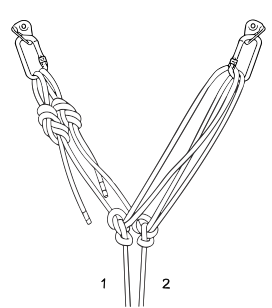
The angle of the Y is everything
Drag the slider to see how the force on each anchor changes with the angle of the Y. The rope colour tracks the IRATA safety bands.
Snapshot at 120° internal angle
| Angle | Per anchor (kN) | Multiplier (×) | Band |
|---|---|---|---|
| 0° | 0.50 | 0.50× | Safe |
| 30° | 0.52 | 0.52× | Safe |
| 60° | 0.58 | 0.58× | Safe |
| 90° | 0.71 | 0.71× | Safe |
| 120° | 1.00 | 1.00× | Safe |
| 130° | 1.18 | 1.18× | Caution |
| 150° | 1.93 | 1.93× | Caution |
| 160° | 2.88 | 2.88× | Caution |
| 170° | 5.74 | 5.74× | Exceeds WLL |
Formula: per-anchor force = (load⁄2) ⁄ cos(angle⁄2). Thresholds: ≤120° safe, ≤160° caution, >160° exceeds WLL.
Numeric reference table
| Angle | Load on each anchor (with 100 kg load) |
|---|---|
| 0° | 50 kg |
| 60° | 57 kg |
| 90° | 71 kg |
| 120° | 100 kg |
| 140° | 146 kg |
| 150° | 193 kg |
| 160° | 288 kg |
| 161° | 303 kg |
| 177° | 1915 kg |
| 178° | 2873 kg |
| 179° | 5747 kg |
The formula
Load at each anchor = (L ÷ 2) ÷ cos(½ A)
Where L is the load and A is the angle of the Y.
Worked example for A = 120° and L = 100 kg:
Anchor Load = (100 ÷ 2) ÷ cos 60° = 50 ÷ 0.5 = 100 kg.
Failure-of-one-anchor swing
Where the anchor points for a Y-hang are located a reasonable distance apart, consider the effects of the failure of one of the anchors (e.g. a swing likely to cause personal injury).
Deviations — single & double
Redirecting ropes around hazards, and the deflection angle that drives loading.
Deviations
A deviation redirects the path of the ropes from the anchor points to either:
- Avoid a hazard or abrasion of the ropes (and other potential causes of damage), or
- Provide more accurate access for the operative.
Deviation anchors should be full-strength slings or rope anchored to the structure.
Single deviation
A single deviation is used to position the technician — where the consequence of anchor failure would be a small swing which has no potential for injury or rigging damage.
Double-anchor deviation
Used to deviate the ropes by a greater angle and distance than a single anchor deviation, and/or to protect against more serious hazards such as a sharp edge, hot pipe, or a large swing into a structure.
A double-anchor deviation uses a double rated anchor system — two suitably rated anchors and connection components — to provide protection against failure of any one item.
Rigging a deviation
A deviation may be a sling, strop or rope attached to the deviation anchor, then attached to the ropes via carabiners pulling them to one side. Single deviations should not pull the ropes such a distance that, in the event of failure of the single deviation anchor point, a swing likely to cause personal injury, damage to property or abrasion could occur.
Effect of angle on loading
Drag the slider to see how the force on the deviation anchor changes with the deflection angle. The rope colour and recommendation track the IRATA hierarchy — single, double-anchor, or step up to a re-anchor.
Snapshot at 30° deflection
| Angle | Anchor force (kN) | Multiplier (×) | Band |
|---|---|---|---|
| 0° | 0.00 | 0.00× | Single deviation OK |
| 15° | 0.26 | 0.26× | Single deviation OK |
| 20° | 0.35 | 0.35× | Single deviation OK |
| 30° | 0.52 | 0.52× | Use a double-anchor deviation |
| 45° | 0.77 | 0.77× | Use a double-anchor deviation |
| 60° | 1.00 | 1.00× | Use a double-anchor deviation |
| 75° | 1.22 | 1.22× | Consider a re-anchor |
| 90° | 1.41 | 1.41× | Consider a re-anchor |
Formula: anchor force = 2 · sin(θ⁄2) × load. Thresholds: ≤20° single deviation, ≤60° double-anchor deviation, >60° re-anchor.
Numeric reference table
| Deflection from vertical | Anchor load (with 100 kg load) |
|---|---|
| 0° | minimal |
| 20° | 34 kg |
| 45° | 70 kg |
| 60° | 100 kg |
| 75° | 122 kg |
| 90° | 141 kg |
The formula
Anchor force = 2 × L × sin(½ θ)
Where L is the suspended load and θ is the total deflection angle between the rope above and below the deviation. Both rope segments carry tension L; the anchor takes the vector sum.
Rope protection — Remove, Avoid, Protect
The hierarchy for protecting ropes against hazardous surfaces (IRATA ICOP Annex P).
Rope protection
The IRATA ICOP Annex P sets out a clear hierarchy for the protection of anchor lines against hazardous surfaces:
Remove (the hazard, where feasible) → Avoid (the hazard, with re-anchors or deviations) → Protect (against the hazard with rope protection measures).
Pre-work planning
It is an essential part of pre-work planning and risk assessment that any threat to the integrity of the rope system is identified and dealt with in an unquestionably effective manner.
- Scrutinise the intended path of the ropes in detail from top to bottom.
- Consider sideways/lateral movement of the ropes during operations.
When edges can't be avoided
Where possible, every effort should be made to use rigging solutions to keep the ropes away from sharp or hot surfaces — Y-hangs, deviations and re-belays. Additional rope protection may still be required to protect against sideways/lateral movements.
Where it is not possible to avoid contact with hazardous edges, effective rope protection must be deployed.
Sufficient protection
In order to offer sufficient protection, the surface or edge should be increased to greater than 5 mm and covered with a layer of suitable and sufficient padding. In addition:
- Each rope should have its own rope protector.
- Canvas rope protectors should be attached to the ropes with a solid link — i.e. directly connected to an Alpine Butterfly knot.
Wire sling bypass arrangements may also be considered as a further layer of protection.
Edge rollers and protective edge plates may also be considered as an alternative to canvas rope protectors — but always in addition to suitable and sufficient edge padding.
Rope security — stopper knots
All ropes, whether reaching ground level or not, should have a stopper knot tied at a suitable point to:
- Prevent the operative from accidentally descending off the end of the rope.
- Bunch the sheath of the rope up against the knot in the event of serious shock loading with an ascender — this might prevent the operative falling all the way to the floor.
It is important not to have excess rope coiled on the floor.
Anchors
Choosing reliable anchors, the 15 kN minimum, and tensioned-line considerations.
Anchors — general
All anchor points used in rope access should be unquestionably reliable and capable of withstanding any potential loads.
Examples of suitable anchor points
- Structural steelwork with a Minimum Breaking Strength (MBS) of 15 kN in the direction it would be loaded in normal use.
- Suitably tested mechanical and chemical anchors.
- Concrete features.
- Substantial geological features.
- Large trees.
- Cradle rails proven to hold a 6 kN force for 15 seconds between fixing posts.
Strength requirement
The strength of all anchor systems (except intermediate deviation anchors, which may be weaker) should be at least as great as that of the ropes attached to them.
Tensioned anchor lines
When anchor lines are tensioned — for example, when creating a horizontal or diagonal tensioned line — the increase in forces at the anchor points and other components in the system should be taken into account and calculated by a competent person.
Mechanical & chemical anchor bolts
Bolt anchor installation, testing and the rules in BS 7985 / BS EN 7883.
Mechanical & chemical anchor bolts
Rope access bolt anchors must comply with EN 795, and the substrate must be proven to withstand a 12 kN force applied to a sample area of 0.6 m² over a period of 3 minutes in the direction it would be applied in service.
Installation should be in accordance with BS EN 7883.
Minimum anchor strength
BS 7985 requires anchorages to have a minimum strength of 15 kN.
For eyebolts or other types of temporary anchors, this minimum may be obtained by linking and equally loading two EN 795 anchors with suitable knots (e.g. a Y-hang).
For aid climbing bolt anchors, a suitably competent person should ensure that the structure is engineered to be able to withstand a force of 15 kN in the direction it would be loaded in normal use.
Types
Three main fixing types exist — selection depends on the substrate:
- Mechanical (expansion).
- Chemical (resin).
- Bolt-through.
A resin anchor should be used if it was considered the expanding action of a mechanical anchor might fracture the host material.
Reusable holes
A sleeve-type resin or expansion anchor can be left in the hole, the hanger plate removed and the hole capped. The anchor can then be subsequently re-used on return visits by uncapping the hole, replacing the hanger plate and re-testing to the required load.
Good-practice installation rules
- Anchor bolts for rope access must always be used in pairs.
- The host substrate should be carefully checked for cracks and other weaknesses.
- The correct anchor type must be selected for the substrate material.
- Pairs of bolts should be aligned correctly in relation to the intended load direction.
- Holes should be drilled at 90° to the surface and to the correct depth using the depth gauge on the drill.
- Hole diameter is dependent on bolt diameter and fixing type.
- The minimum distance between 12 mm bolts should be 150 mm if full strength is to be retained. (Some manufacturers allow closer placement under strict criteria.)
- Clean holes with a suitable hole brush and blow out — especially important for chemical anchors.
- Expansion bolts should be torqued to the value specified by the manufacturer.
- Resin anchors should be given time to cure — which may be temperature-sensitive.
- The bolt head or hanger should sit flush with the surface.
Ground, dead-weight, beam clamps & roof structures
Anchorages used when conventional structural anchors aren't available.
Other anchor systems
Ground anchors
The operative may be required to operate in an area where no anchor points are readily available. In these cases it may be possible to:
- Utilise suitable ground-driven anchors.
- Attach to suitable points on a motor vehicle (that has been effectively isolated and rendered immovable), with ropes going up and over the building.
Dead-weight anchors
Where no anchor points are available on the roof, dead-weight anchors may be used.
Particular account should be taken of cantilever and frictional effects. Wet or icy conditions can significantly affect frictional performance.
The frictional resistance of any anchor weight should be assured by checking that it does not move when subjected to a load of 4× that which could be applied in a work positioning situation. In a rescue the system may have the weight of two persons applied — consider the effect of a main rope failure during a rescue.
Also consider the stretch potential in the rope and unusual abrasion points. Always refer to the manufacturer's instructions before using these anchor systems.
Beam clamps
Beam clamps can provide a simple and portable attachment point.
Refer to the user information supplied with the product.
Using roof buildings & structures as anchorages
It is often possible to anchor ropes inside or around a sub-building situated on the roof, with the ropes radiating out to the required points on the roof edge.
- All textiles used for rigging must be suitably protected against abrasion and cutting.
- Where the anchor itself may cause damage to rope or textile slings, use canvas rope protectors or install wire slings.
Steel cables around sub-buildings
The most common method is to utilise two 12 mm steel cables.
- Protect at the corners of the roof building to ensure damage doesn't occur to either the cable or the building.
- Follow your company's own written procedures for fixing methods.
- Bulldog clips should be attached with the saddle on the 'Live' end of the cable.
Using structural steel
Where structural steel members are to be used as anchorages, it is imperative they are soundly attached to the building roof or walls.
- Check all necessary fixings are in place and tight.
- It would be advisable to use steel attached by nuts and bolts — welded fixings may require Non Destructive Testing (NDT) prior to use.
Chapters · 08
Rope Access Manoeuvres
Pre-use checks, safe access to the ropes, ascending and descending, changeovers, transfers and passing obstacles.
Rope access manoeuvres
Before any work is carried out, ensure that the level of supervision is appropriate to the work situation — both in the numbers of operatives being supervised and the skill levels of the operatives being appropriate for the tasks.
Supervision
- The supervisor's role is to ensure that all work is carried out in accordance with the method statement, to ensure no accidents, no wastage of materials and no defects in the work being carried out.
- Operatives who have had a significant break from rope access work should undergo refresher training at the appropriate level prior to commencement.
- Newly qualified operatives should be subject to close supervision until deemed competent.
- Worksites with more than one discrete working area must have appropriate supervision in each — generally no more than 4 operatives per 1 supervisor.
On larger sites where communication is a problem, consider the provision of two-way radios and their correct use. Permission should be sought from the site manager before radios are used.
Pre-use checks & safe access to the ropes
What to check before leaving the safe ground, and how to handle the danger zone.
Pre-use checks & safe access to the ropes
Pre-use check
All suspension equipment needs to be checked prior to each use. Level 1 technicians should have their equipment inspected by the Level 3 Safety Supervisor or his nominated person.
Safe access to & from the ropes
- Where possible, the operative will attach or detach from both safety and working ropes 2 m away from unprotected edges where there is no risk of falling.
- If this cannot be achieved, cow's tails, lanyards or other suitable equipment must be used to protect the operative whilst in the danger zone between safe ground and the ropes.
- If there is a risk of falling a distance likely to cause personal injury, a fall arrest harness and energy-absorbing lanyard should be used.
Descending
Setting up, going over the edge, controlling the descent and releasing a loaded back-up.
Descending
- If safe access to the ropes is not available, protection needs to be maintained by other means until the operative is secured on both ropes.
- At the top of the rope drop, first attach the back-up device, then the descender to their respective ropes.
Locking off & moving over the edge
- Lock off the descender so that when the working rope is under tension it will overcome the edge of the drop and sit within 0.3 m of the top of the drop.
- The correct procedure for locking off a descender will be shown by your instructor and found in the information leaflet supplied with the device.
- Move the safety back-up device on the back-up rope to a position which minimises any falling distance.
- Move over the edge in a controlled manner until your weight is transferred to the working rope.
- Check that all equipment is loaded correctly and that it is safe to descend.
The descent itself
- Ensure the back-up device travels freely down the rope as you descend.
- The controlling arm should be tucked into the body and the controlling hand positioned approx. 500 mm below the descender — allowing the device to be safely locked off if damage to the rope sheath is discovered during the descent.
- If you need to stop and use both hands for a work task, ensure your descender is first locked off.
- Once locked off, position the back-up device high up on the safety rope to minimise both the falling distance and the shock load to the system should the working rope fail.
Releasing a loaded back-up
To release a back-up device that has become loaded onto the safety rope:
- First ensure the descender device is securely locked off.
- Attach a handled ascender to the safety rope, a good distance below the back-up device.
- Stand in the foot loop — the stretch in the back-up rope will generally allow you to de-weight the back-up device.
If this is not possible, follow the "De-Weighting a Loaded Safety Rope during a Rescue" procedure.
Ascending
Chest ascender, handled ascender and foot loop — the basic ascent cycle.
Ascending
- First attach the back-up device to the safety rope.
- Attach the chest ascender to the working rope.
- Attach the handled ascender and foot loop to the working rope above the chest ascender.
The cycle
- Stand in the foot loop so that the handled ascender is weighted and the working rope will ride through the chest ascender. If the rope drags through the chest ascender, hold the rope coming out of the bottom in your hand or grip it between your feet. Sit back and rest on the chest ascender again.
- Lift your feet and move the handled ascender further up the rope.
- Repeat by standing up in the foot loop attached to the handled ascender.
Back-up device position
The back-up device should be kept as high as possible (in all cases above waist height) on the safety rope throughout the ascent — to help minimise the fall distance should the working rope fail.
The technique used for moving the back-up device should not affect the operation of the device.
Changeovers — ascent to descent & back
Switching modes mid-rope safely.
Changeovers
Changing from ascent to descent
- Place the back-up device high up on the safety rope.
- Attach the descender device onto the working rope, directly below the chest ascender.
- Take in any slack rope through the descender until approximately 50 mm remains between the descender and the chest ascender.
- Lock off the descender.
- Move the back-up device to a position just above waist height.
- Position the handled ascender at head height so that when standing in the foot loop, weight will just be taken from the chest ascender.
- Stand up in the foot loop whilst disengaging the chest ascender, and then sit back onto the descender, which will then become weighted.
- Remove the handled ascender and foot loop from the working rope and begin to descend.
Changing from descent to ascent
- Stop the descent. Lock off the descender and position the back-up device high up on the safety rope.
- Attach the handled ascender to the working rope above the descender, leaving room between the two to allow attachment of the chest ascender.
- In one movement: stand up in the foot loop, locate the chest ascender onto the working rope, close the cam, and sit back onto the chest ascender.
- Remove the descender from the working rope and begin to ascend.
Rope-to-rope transfer
Moving between two pairs of ropes safely, maintaining two-point security throughout.
Rope-to-rope transfer
Before attempting any rope-to-rope transfer, ensure you are in descent mode.
- Lock off the descender and position the back-up device high up on the safety rope.
- Take hold of the new working rope and attach both ascenders to it, taking care to pull through all slack rope so that the chest ascender is in tension.
- Place a secondary back-up device on the second back-up rope.
- Descend the original working and safety ropes until the weight is transferred to the new ropes.
- Remove the descender and back-up device.
- Place the back-up device on the new safety rope above the knot, remove the cow's tail and untie the knot.
Passing knots
Crossing a knot mid-rope in both ascent and descent modes.
Passing knots (ascent & descent mode)
Descent — knot in working rope
- Descend until the knot is approx. 50 mm from the entry point into the descender device. This effectively locks the descender. Ensure the back-up device is high up on the safety rope.
- Attach the handled ascender to the working rope above the descender. Stand in the foot loop and attach the chest ascender above the descender.
- Remove the descender and replace it on the working rope below the knot. Lock off the descender.
- Progress downwards on the ascenders (reverse prussik), moving the back-up device down as you descend, until the chest ascender is just above the knot.
- Standing in the foot loop, remove the chest ascender and sit back on the descender.
- Remove the handled ascender and continue to descend.
Descent — knot in safety rope
- Descend until just below the knot and lock off the descender.
- Attach 2nd back-up high above the knot.
- Remove the original back-up device and re-attach it below the knot.
- Remove the 2nd back-up, unlock the descender and continue to descend.
Ascent — knot in safety rope
Carry out the descent (knot in safety rope) procedure in reverse.
Ascent — knot in working rope
- Ascend the ropes until just below the knot, ensuring the back-up device is placed high up on the safety rope.
- Remove the handled ascender and replace it on the working rope above the knot.
- Step up a little to bring the chest ascender to just below the knot, and attach the descender below the knot.
- In one movement, stand up in the foot loop, remove the chest ascender and replace it above the knot.
- Remove the cow's tail from the loop of the knot and continue to ascend.
Passing deviations & re-anchors
Single and double deviations, plus how to handle re-anchors.
Passing deviations & re-anchors
Where the direction of the ropes needs to be changed slightly — either to avoid abrasion or to afford the technician more efficient access — a deviation is installed.
Single deviation
Ascent
- Ascend until level with the deviation anchor point.
- Place the ropes below your chest ascender and back-up device into the spare carabiner of the deviation.
- Once in place, pull yourself into the deviation anchor point sufficiently to remove the original deviation carabiner, and gently lower out using the trailing ropes below.
- Continue with the ascent.
Descent
Carry out the above operation in reverse.
Double deviations
Passing re-anchors
Where the direction of the ropes needs to be changed and it is not practicable to use a deviation either to avoid abrasion or to afford the operative more efficient access, a re-anchor should be installed — a double anchor point part-way down the drop into which the ropes are originally knotted and attached.
This manoeuvre can be treated as a rope-to-rope transfer in both ascent and descent. Your instructor will demonstrate.
Pull-through
Installing and retrieving ropes from a position where direct access to the belay isn't possible.
Pull-through
This technique should be used only if there are no other means of carrying out the task.
Descending & de-rigging
- Both the working and back-up ropes should be passed around the structure — ensuring both ends of each rope have a security knot and they reach the floor.
- Tie a knot on one side of each rope (Alpine Butterfly or similar) just below the structure and connect carabiners to the loops created.
- Clip these carabiners to the ropes hanging on the opposite side of the structure and pull tight.
- First attach your back-up device and then your descender to the live ropes and descend.
- Upon reaching ground level, remove all equipment and any knots. Pull the ropes down.
Ascending & rigging
- Throw a thin line over the structure.
- Attach the working and safety ropes to the line.
- Tie the appropriate knots at the half-way point.
- Attach carabiners in the manner shown to you.
- Pull the ropes until they are in the final position.
The risks
Dependent on the shape of the structure, it is possible that the connector could be abnormally loaded during use. Consider the use of appropriate Maillon Rapide connectors in such circumstances.
Horizontal & vertical aid climbing
Making progress along or up a structure using anchor points or wire slings.
Aid climbing
Horizontal aid climbing
This technique is used to make horizontal progress whilst suspended from a structure or a series of suitable anchor points.
Three cow's tails will be required (two long and one short), so as to maintain two independent points of attachment whilst re-positioning a third.
From the top of a set of ropes
- Ascend the ropes stopping just below the aid route.
- Remove the top (handled) ascender and attach its cow's tail directly into the anchor point carabiner — this is the trailing cow's tail.
- Remove the back-up device and attach its cow's tail to the first free anchor point carabiner. Attach an etrier to this cow's tail — the leading cow's tail.
- Stand in the foot loop and etrier, remove the chest ascender and attach the short cow's tail to the same anchor point carabiner as the leading cow's tail.
- Remove the leading cow's tail and move it forward to the next free anchor point carabiner.
- Remove the trailing cow's tail and re-attach it to the short cow's tail anchor point carabiner.
- Stand in the foot loop and etrier and remove the short cow's tail, re-attaching it to the leading cow's tail anchor point carabiner.
- Repeat the procedure — systematically moving the cow's tails in the direction of travel.
Along a structure with wire/webbing slings
- Attach the leading and trailing cow's tails to the two outside slings and attach the short cow's tail to the central sling.
- De-weight the central sling by standing in the foot loop and/or etrier and move this sling in the direction of travel.
- Re-weight the central sling and move the leading and trailing slings in the same direction.
- Repeat until a junction is encountered. Pass the obstruction by removing one sling at a time whilst maintaining two independent attachments.
Vertical aid climbing
This technique is used to make vertical progress whilst suspended from a structure or a series of suitable anchor points.
A double energy-absorbing lanyard attached to the sternal attachment on the harness, and a short cow's tail, will be required — so as to maintain two independent points of attachment whilst re-positioning a third.
Your instructor will show you a variety of methods to vertically aid climb. One sequence:
- Attach short and long cow's tail to first anchor and place second long cow's tail on second anchor.
- Then move the long cow's tail on the first anchor to create a third anchor above the second.
- Step up using foot loops and place the short cow's tail into the next anchor point.
- Repeat.
Horizontal & diagonal tensioned lines
Tensioned traverses, lifelines and the angle-loading effects to plan for.
Tensioned lines
Horizontal lifelines
The main consideration when setting up a horizontal lifeline is the effect of angle loading on the system. The load on the lifeline and the anchors may be up to three times the load imposed on it.
Drag the sliders to see how span and sag combine into anchor tension — small sag means big force.
Snapshot: 15 m span, 1 m sag, 100 kg load
| Scenario | Angle | Mult. | Tension (kN) | Band |
|---|---|---|---|---|
| 15 m span, deep 3 m sag | 21.8° | 1.3× | 1.32 | ≤ 3× — well rigged |
| 15 m span, 1.5 m sag (10%) | 11.3° | 2.5× | 2.50 | ≤ 3× — well rigged |
| 15 m span, 1.0 m sag | 7.6° | 3.8× | 3.71 | 3–5× — typical IRATA practice |
| 15 m span, tight 0.5 m sag | 3.8° | 7.5× | 7.37 | > 5× — re-rig with more sag |
| 20 m span, very tight | 1.7° | 16.7× | 16.36 | > 5× — re-rig with more sag |
| Long 30 m line, 0.5 m sag | 1.9° | 15.0× | 14.72 | > 5× — re-rig with more sag |
Anchor tension = (load × g) ÷ (2 · sin θ), where θ is the angle from horizontal. Halving the sag roughly doubles the anchor force. Bands: ≤3× well rigged, 3–5× typical practice, >5× re-rig with more sag.
- Solid anchor points should be selected at each side of the lifeline.
- Intermediate anchors placed a maximum of 5 m apart.
- The lifeline should run freely through the intermediate anchors (not knotted).
- The rope should be hand tensioned through the descender.
- The maximum allowable incline is 15° — anything above 15° should be treated as a vertical lifeline.
- The lifeline should be rigged as high as possible in relation to the user to minimise potential falls.
Horizontal tensioned traverse lines
A horizontal tensioned traverse line will normally comprise two separate ropes running side by side in a horizontal plane, each rope separately anchored at both ends.
The operative or casualty should have two attachments to the ropes and maintain them at all times during the traverse. This can be achieved by attaching a short cow's tail to both ropes and then attaching a long cow's tail into both ropes.
Other equipment may assist movement along the traverse:
- A back-up device placed on one rope, trailing behind the operative to help control the descent down the first half of the traverse.
- A handled ascender to assist during the second, upward half.
Your instructor will show you these techniques and illustrate their limitations and potential dangers.
Operatives should be aware that unnecessary dynamic movement whilst traversing will place additional peak loads on the anchor point and associated connectors — possibly exceeding their designed Working Load Limit (WLL) or Safe Working Load (SWL).
Work restraint capability
These systems may also be used to offer a Work Restraint capability. Ensure the system does in fact prevent an operative from entering a falling hazard zone. Where such a system is in place, ensure all operatives are familiar with the maximum length of cow's tail / lanyard to be used on the system. It is acceptable to utilise a single rope in these situations.
Diagonal tensioned traverse lines
Diagonal tensioned traverse lines redirect the path of a descent or ascent from the vertical to a diagonal plane. They are used in addition to the operative's working and safety ropes, or the double-rope systems used for hauling and lowering.
- Similar in construction to horizontal lines — two separate ropes side by side, each separately attached to independent anchors at both ends.
- One end of the traverse ropes can be attached via suitable descender devices to enable the system to be tensioned or slackened.
- If tensioned, the angles created when loaded should be considered (deflection will be small and a high load will be exerted on the anchors).
Use as work positioning
The operative should descend or ascend their ropes in the normal way, whilst having two extra attachments to both traverse ropes. Rope can be taken in and out through the rope adjustment devices at any point during the ascent or descent — enabling the operative's position to be altered in both vertical and horizontal planes.
Use for rescue
The same system of double security should be employed — the casualty should be lowered on two independent systems whilst maintaining two attachments to the tensioned traverse lines.
Chapters · 09
Fall Arrest
Choosing fall arrest equipment, calculating clearance distances, fall factors and the risk of suspension trauma.
Fall arrest
If the planned method of work is such that should the user lose controlled physical contact with the working surface there will be a free fall, it will be necessary to choose fall arrest equipment.
This will include:
- A full-body harness that meets the requirements of EN 361.
- An energy absorber conforming to EN 355.
- A double lanyard system to allow forward progression without disconnecting from the structure. The lanyards should conform to EN 354.
Clearance distances & golden rules
The 6 m clearance for a 2 m lanyard, plus the do's and don'ts of using fall arrest kit.
Clearance distances
For a typical 2 m energy-absorbing lanyard, measured from the lanyard anchor point:
Lanyard length + Deployment length + Safety factor 2 m + 1.5 m + 2.5 m = 6 m clearance.
Drag the sliders to see whether a given anchor height clears the required fall path.
Snapshot: 6 m anchor, 2 m lanyard, 1.5 m absorber, 2.5 m safety
| Scenario | Anchor (m) | Required (m) | Margin (m) | Band |
|---|---|---|---|---|
| Low anchor, 2 m lanyard | 4.0 | 6.0 | −2.0 | Insufficient clearance — DO NOT use this rig |
| Chapter example (6 m clearance) | 6.0 | 6.0 | +0.0 | Margin tight — re-rig higher if possible |
| Comfortable anchor height | 8.0 | 6.0 | +2.0 | Clearance — at least 1 m margin |
| Shorter lanyard, smaller deployment | 6.0 | 5.0 | +1.0 | Clearance — at least 1 m margin |
| Tall structure, worst-case deployment | 12.0 | 6.3 | +5.8 | Clearance — at least 1 m margin |
Required clearance = lanyard length + absorber deployment + safety factor. Bands: ≥ 1 m margin safe, 0–1 m marginal, < 0 m insufficient.
When the height is less than the clearance
When working at heights of less than 6 m, it is always good practice to attach a suitable-length lanyard to a high point on the structure. In the event of a fall, the impact force with the ground or supporting structure would be considerably reduced.
The golden rules
-
ALWAYS ensure fall arrest attachment points are kept as high as possible in order to reduce fall heights to a minimum.
-
NEVER use an energy absorber that has been partially deployed. In the event of a fall the Peak Impact Force could be in excess of the 6 kN that a body can absorb.
-
When using a double energy absorber, ensure that the lanyard not in use is NOT connected to any part of the harness. In a fall, the energy absorber would effectively be bypassed — causing a possible failure of the lanyard webbing.
-
NEVER use two single energy-absorbing lanyards to make progress along a structure. In the event of a fall onto both lanyards, the maximum peak impact force applied to the body would be double the force using a single energy absorber.
-
NEVER lengthen an energy-absorbing lanyard by adding attachment slings that are too long. Energy absorbers are designed to reduce Peak Impact Forces of a 100 kg person falling double the length of the lanyard to below 6 kN. Considerably lighter or heavier operatives may generate considerably greater impact forces.
-
NEVER clip the lanyard's connector around the structure and then back onto the lanyard. In the event of a fall the connector could have a load applied across the gate, possibly in excess of the MBL in this orientation. Large 'Scaffcrab' type connectors will also be affected by this 'cross loading' when connecting to irregular shaped structures.
-
When using a mobile fall arrester (EN 353-2) on a flexible line, ALWAYS ensure there is a stopper knot at the base of the route to ensure protection from falling 'over the edge'.
Inspection frequency
BS EN 365:1993 gives general requirements for periodic inspections of PPE against falls from height. PPE Regulations require components to be examined at least every twelve months.
HSE Specialist Inspector Report No. 59 states that for textile items, this period should be reduced to every six months, and for arduous environments, every three months or more frequently if the risk assessment shows special hazards.
Fall factors
How fall factor is calculated, the FF0 / FF1 / FF2 reference, and the danger of via-ferrata scenarios.
Fall factors
Fall Factors measure the relative severity of a fall in terms of the shock loads placed upon the equipment and user.
The formula
Fall Factor (FF) = Length of fall ÷ Length of rope holding the fall
Drag the sliders to see how anchor position and lanyard length combine into fall factor and peak rope tension.
Snapshot: 1.5 m lanyard, anchor level with attachment — FF 1.00
| Scenario | FF | Fall (m) | Peak (kN) | Band |
|---|---|---|---|---|
| Anchor overhead, taut | 0.00 | 0.0 | 2.0 | FF ≤ 0.3 — low-stretch rope OK |
| Anchor well above attachment | 0.33 | 0.5 | 5.5 | FF ≤ 1 — dynamic rope only |
| Anchor above attachment | 0.67 | 1.0 | 7.3 | FF ≤ 1 — dynamic rope only |
| Anchor at attachment (FF1) | 1.00 | 1.5 | 8.7 | FF ≤ 1 — dynamic rope only |
| Anchor at knees | 1.50 | 2.3 | 10.4 | FF > 1 — energy absorber mandatory |
| Anchor at feet (FF2) | 2.00 | 3.0 | 11.9 | FF > 1 — energy absorber mandatory |
| Long lanyard, anchor at feet | 2.00 | 4.0 | 13.5 | FF > 1 — energy absorber mandatory |
Fall factor = free-fall distance ÷ lanyard length, capped at 2. Peak rope tension assumes a 100 kg operative and a representative 20 kN/m rope stiffness with no energy absorber. A correctly deployed absorber limits peak force to ≤ 6 kN.
Limits in practice
It is important to ensure that the Fall Factor is kept to a minimum.
- Dynamic rope is capable of withstanding a FF2 fall when new — but good practice is not to exceed FF1.
- Low Stretch rope — good practice is not to exceed FF 0.3.
| Scenario | Fall Factor |
|---|---|
| Anchor above the user, fall ≤ rope length used | FF 0 |
| Anchor at user's feet, fall = rope length used | FF 1 |
| Anchor below user, fall = 2× rope length used | FF 2 |
Lead climbing
During lead climbing situations, any potential fall should be mitigated by the use of appropriately spaced 'Running Belays' to reduce the fall height — and thus the Fall Factor — placed on the system.
The higher a climber ascends with sufficient running belay protection, the lower the resulting Fall Factor. The overriding consideration is reducing any potential fall height.
Beyond FF2 — via ferrata
In some situations it is possible to generate Fall Factors in excess of FF2.
Example: if you were clipped to the handrails on a bridge suspension cable and you fell, the fall height would be calculated from the height at which you fell to the height at which your fall was arrested. On the Humber Suspension Bridge this height could in some cases be as much as 4 m. With a 1 m cow's tail the fall factor would be FF4.
This does not allow for the friction between the handrail and the cow's tail carabiner slowing down the fall — but it highlights the potential for very high Fall Factors.
Some equipment manufacturers produce energy absorbers specifically for high Fall Factor situations.
Suspension syncope / trauma (toxic shock)
Why an immobile, suspended person can deteriorate within minutes, and how to handle the rescue.
Suspension syncope / trauma (toxic shock)
Anecdotal evidence suggests that an immobilised person suspended in a harness will begin to deteriorate after as little as four minutes — leading to coma and possibly death.
The symptoms
Suspension trauma is a condition in which a person suspended in a harness can experience:
- Pallor, cold sweats, nausea
- Ringing in the ears, blurred vision, dizziness
- Feeling faint, loss of consciousness, and eventual death
The condition appears only to have a serious effect on persons suspended in a harness with a dorsal attachment without moving — for example, when unconscious.
Why it happens
Muscular action in moving the limbs normally assists the return against gravity of blood in the veins back to the heart. If the legs are completely immobile, these 'muscle pumps' do not operate and an excess of blood accumulates in the veins — venous pooling.
Pressure from harness straps on veins and arteries could also be a contributory factor. The reduction of circulating blood volume disturbs the circulatory system, leading to critical reduction of blood to the brain.
The danger during rescue
Moving a person with venous pooling into a horizontal position can cause a massive flow of venous blood to the heart, which cannot cope — potentially causing fatal cardiac abnormalities.
In several clinical trials where test subjects were told not to move, most experienced many of the symptoms of suspension trauma — some including loss of consciousness — in just a few minutes.
Risk reduction
Steps that can minimise the risk:
- Frequent 'pumping' of the legs, preferably against a firm surface, activates the muscles and reduces venous pooling.
- Harness leg loops should be well-padded and as wide as possible to spread the load and reduce restrictions.
- The use of a work seat might be advisable if work in one position is to be sustained for an extended period.
Work seats
Your instructor will demonstrate a variety of work seats currently in use.
During the rescue
It would be advisable for the casualty to be sat-up with the knees elevated slightly. This can be achieved by suspending the casualty from the sternal attachment point and, if possible, positioning the harness leg loops under the knees — elevating them and avoiding a rapid return of venous blood to the heart.
The eventual movement of the casualty to the horizontal should be carried out over an extended period of around 20–30 minutes. Medical advice should always be sought.
Chapters · 10
Rescue
Rescue principles, snatch rescues, deviation and re-anchor rescues, mid-transfer, knot, aid-climb and loop rescues.
Rescue
The requirement for rescuing any team member who becomes incapacitated whilst working at height should be identified at the Risk Assessment stage and fully described in the Rescue Plan.
If the rescue scenario is particularly complicated, a practice rescue should be carried out to ensure the proposed method can be successfully completed within an acceptable time span.
Rescue equipment
Rescue equipment, including a suitable First Aid kit, should accompany all operational rope access teams. This includes sufficient equipment to rescue a technician from any of the rope access situations in which they may be operating.
It is essential to ensure that enough competent team members are available to assist.
Rig for rescue
If the risk assessment shows that the casualty's position cannot be reached by the rescuer, or that the time required to set up and implement a rescue would prove too lengthy, then a 'Rig For Rescue' system should be pre-rigged before work commences to allow safe and timely access and egress of the worksite.
Before any rescue
The IRATA Level 3 Safety Supervisor:
- Assesses the situation.
- Attempts to communicate with the assumed casualty to ascertain his/her condition.
- Determines whether or not a rescue is necessary.
The supervisor should hold, as a minimum, a current HSE Appointed Person Certificate. Where the location of the work is deemed to be an extreme location — where evacuation of a casualty could take hours instead of minutes — additional first-aid training or emergency cover may be required.
Rescue team's orders of priority
- Ensure the rescuers do not endanger themselves whilst carrying out the rescue.
- Provide appropriate First Aid Treatment and prevent further injury to the casualty.
- Evacuate the casualty to a safe location where suitably qualified persons can administer effective treatment.
Casualty management must be constantly addressed throughout the rescue, with the rescuer taking sufficient steps so as not to worsen any injury sustained by the casualty.
Snatch rescue — casualty in descent mode
Approaching, securing and lowering a casualty stuck in descent mode, from below or above.
Snatch rescue — casualty in descent mode
Rescue carried out from below
-
Ascend the casualty's safety rope with your back-up device on the casualty's working rope.
-
Upon reaching the casualty, place them in as near an upright position as possible without endangering the casualty further. This may be achieved by temporarily placing a loop from one side of the chest harness over the top of the descender device.
-
Using a 2nd back-up device, place it above the casualty and move the original back-up above the casualty, removing the secondary back-up.
-
Continue ascending 0.5 m above the casualty and change into descent mode.
-
Remove the casualty's back-up device from the rope.
-
Make an attachment from your descender device carabiner to the top of the casualty's chest ascender or the sternal attachment on the harness, with a short sling or chain of 2 or 3 carabiners.
-
Operate the casualty's descender to lower him/her onto the short sling or chain of carabiners and then remove it from the rope.
-
Before unlocking your descender, employ a braking carabiner to create additional friction. Descend slowly in a controlled manner, avoiding any jerky movements that could shock-load the system, and employing good casualty management.
Your instructor will demonstrate a number of methods of carrying out the above manoeuvres dependent on the type of harness and descender device being used.
Rescue carried out from above
-
Descend the casualty's safety rope with your back-up device attached to the casualty's working rope.
-
Upon reaching the casualty, lock off your descender device and place the casualty in as near an upright position as possible.
-
Make an attachment from your descender device carabiner to the top of the casualty's chest ascender or sternal attachment, with a short sling or chain of 2 or 3 carabiners.
-
Remove the casualty's back-up device from the rope and use this cow's tail to make a second attachment to the main attachment point on your harness. Alternatively, use your own long cow's tail and attach this to the casualty's main attachment point on their harness.
-
Operate the casualty's descender to lower him/her onto the short sling or chain of carabiners before removing his/her descender device.
-
Continue with the rescue as described above.
Snatch rescue — casualty in ascent mode
Removing the casualty's loaded chest ascender via a counter-weighting technique.
Snatch rescue — casualty in ascent mode
Before you start
Before implementing a rescue, confirm one is necessary by first attempting to communicate with the assumed casualty.
If it is deemed necessary, the Level 3 Safety Supervisor should first arrange for the emergency services to be notified to ensure they will be on site to receive the casualty upon completion of the rescue.
Rescue carried out from below
-
Ascend the casualty's safety rope with your back-up device on the casualty's working rope, and follow the same first 6 bullet points as for the snatch rescue (descent mode). The casualty should already be in a near upright position via his/her chest ascender attachment.
-
Attach your foot loop to the top of the casualty's chest ascender, then pass the foot loop through the rescuer's back-up device carabiner. An additional carabiner may be required depending on the type of back-up device and cow's tail/lanyard attachment method.
-
Stand in the foot loop and pull upwards on the casualty's harness. This will lift the casualty enough to enable his/her chest ascender to be disconnected from the rope.
-
Lower the casualty until he/she is suspended and follow the procedure as described previously.
Rescue carried out from above
Descend to the casualty and follow the procedures as described in the snatch rescue (descent mode) from-above section.
Deviation, re-anchor, transfer & knot rescues
Quick reference for the common rescue scenarios past obstacles in the rope system.
Deviation, re-anchor, transfer & knot rescues
Deviation rescues
Single deviation: use a spare carabiner to connect into the ropes above you and the casualty by pulling in on the deviation.
Double deviation: utilise the rope-to-rope transfer method past the double deviation.
Re-anchor rescues
Utilise rope-to-rope transfer with the casualty's descender connected through the rescuer's main work positioning point and the casualty's suspension carabiner.
Mid-transfer rescue
Make connections to the casualty and descend to the rescuer until at the vertical position.
Knot rescue
Rescue the casualty using a rescue rope connected to the working line — transfer with the casualty onto the new rope and descend.
Aid climb, short link & fall arrest rescue
Use the counter-balance method to either descend with the casualty or lower them.
Large re-anchor & stuck-in-loop rescue
Rescuing a casualty trapped in the loop of a re-anchor — the 10-step procedure.
Large re-anchor or stuck-in-loop rescue
For a casualty on the far side of a large re-anchor, utilise the rope-to-rope transfer method.
If stuck in four ropes (i.e. the loop)
Approach from the casualty's ascent side where possible.
- Rescuer ascends ropes to top and changes into descender.
- Rescuer attaches short and long cow's tail onto loop ropes.
- Rescuer descends using the loop as a tensioned rope to the casualty.
- Rescuer removes the casualty's hand ascender and gets as close to the casualty as possible using a gri-gri.
- Rescuer attaches cow's tail to the casualty's central D-ring below the loop.
- Rescuer attaches a short connection between the rescuer's descender carabiner and the casualty's sternal D-ring below the loop.
- Rescuer places an ascender (minus cow's tail and foot loop) on the working rope above their descender. Add a pulley to the hand ascender. The control rope from the descender is run through the pulley. Rescuer places his hand ascender on the rope emerging from the pulley (shorten the foot loop by clipping it back to itself). Rescuer raises the casualty by standing in his foot loop.
- As the rescuer stands, the rope is pulled through the descender — both rescuer and casualty ascend. Rescuer removes the casualty's chest ascender.
- Rescuer unlocks the casualty's descender and lowers across the loop.
- Rescuer climbs the rope through the descender until the casualty's descender has become loose. Once off the loop, rescuer places the control rope through an extra carabiner below the descender on the harness for added friction. Rescuer descends to ground with the casualty.
Chapters · 11
Hauling & Lowering
Mechanical advantage, hauling systems, lowering systems and self-locking pulley setups.
Hauling & lowering rescues
By using a combination of pulleys, descenders, ascenders, belay devices and carabiners, it is possible to set up elaborate hauling and lowering systems — employing the same double rope security — allowing the speedy evacuation of an injured operative from the most difficult of locations.
Typically 2:1, 3:1, 6:1 and 9:1 mechanical advantages (theoretical) and counterweight systems are used during the hauling element, and subsequently disengaged to allow the casualty to be lowered to a new position.
A suitable method of paying out the back-up rope should be adopted — with special consideration given to the effects following failure of the main lowering rope.
When to rig for rescue
Where operatives are required to operate in a confined space, give consideration to 'Rigging for Rescue'.
A suitable self-locking descender device pre-attached to the working rope allows for easy and quick implementation of a rescue hauling system in the unlikely event of a rescue situation developing. The same Rigging for Rescue system should be implemented wherever there is a need for the casualty to be hauled up to a safe location.
Mechanical advantage — 1:1 to 9:1
How much rope you pull for each metre of load lifted in common pulley systems.
Pulley systems — mechanical advantage
| System | Mechanical advantage |
|---|---|
| 1:1 | Single fixed pulley — no advantage, only redirects the load. |
| 2:1 | One moving pulley at the load — pull twice the distance for each metre of load lifted. |
| 3:1 | One fixed + one moving pulley — pull three times the distance. |
| 6:1 | Compound system — pull six times the distance. |
| 9:1 | Compound system with additional redirect — pull nine times the distance. |
The higher the mechanical advantage, the less force the operator applies — but the more rope must be pulled through the system.
Snapshot: 3:1 at 8% friction per sheave
| System | Real MA | Input (kN) | Rope to pull (m) | Band |
|---|---|---|---|---|
| 1:1 | 1.00 : 1 | 1.00 | 10.0 | Good efficiency |
| 2:1 | 1.92 : 1 | 0.52 | 20.0 | Good efficiency |
| 3:1 | 2.77 : 1 | 0.36 | 30.0 | Good efficiency |
| 4:1 | 3.55 : 1 | 0.28 | 40.0 | Good efficiency |
| 5:1 | 4.26 : 1 | 0.23 | 50.0 | Good efficiency |
| 6:1 | 4.92 : 1 | 0.20 | 60.0 | Good efficiency |
| 9:1 | 6.60 : 1 | 0.15 | 90.0 | Fair — friction is biting |
Friction model: real MA = (1 − ηN) ⁄ (1 − η), where η = 1 − f and N = strands at the load. Bands: ≥80% good, 50–80% fair, <50% poor.
Self-locking pulley systems
Using an ascender or descender as the locking element, and the always-required back-up system.
Self-locking pulley systems
Ascender + pulley at the anchor
When an ascender is incorporated with a pulley at the main anchor point, the rope is stopped from sliding back over the pulley. This is the most efficient type of hauling system as it produces the least friction.
It is limited by the fact that a load cannot be lowered without introducing a lowering system. The hauling system shown in your training materials gives a 3:1 mechanical advantage.
Descender as the locking device
More friction is introduced to the system by the addition of a descender as the locking device. This system is more versatile as it can be converted easily to a lowering system. However, because the system is based around a 2:1 mechanical advantage, a rope that is double the length of the lowering distance is required.
The hauling system in this configuration provides a 6:1 mechanical advantage.
Toggle between the two systems and see how cam grip changes the rope required per metre lifted.
Snapshot: Ascender + pulley (3:1) at 8% friction, 98% cam grip
| Scenario | Real MA | Input (kN) | Rope (m) | Band |
|---|---|---|---|---|
| Ascender + pulley, perfect grip | 2.77 : 1 | 0.36 | 3.00 | Cam grip ≥ 95% — safe to use |
| Ascender + pulley, 95% grip | 2.77 : 1 | 0.36 | 3.16 | Cam grip ≥ 95% — safe to use |
| Ascender + pulley, worn cam | 2.77 : 1 | 0.36 | 3.41 | Cam grip < 90% — REPLACE the device |
| Descender + pulley, perfect grip | 4.92 : 1 | 0.20 | 6.00 | Cam grip ≥ 95% — safe to use |
| Descender + pulley, mid-life cam | 4.92 : 1 | 0.20 | 6.52 | Cam grip 90–95% — inspect for wear |
Rope per metre lifted = ratio ÷ (1 − slip). Cam grip below 100% means each pull cycle gives back some height before the cam re-engages. Always pair with an independent back-up.
Always have a back-up
Chapters · 12
Glossary
A reference glossary of terms, acronyms and abbreviations used throughout this manual.
Glossary
A quick reference for the terms, acronyms and abbreviations used throughout this manual. Tap any topic in the chapter list to browse the glossary entries.
A – E
ACWAHT to Exclusion Zone.
Glossary — A to E
ACWAHT — The HSE-led 'Advisory Committee for Work at Height Training'.
Anchor / Anchorage — A place, fixing or fixture to which an anchor line is connected.
Anchor Line / Anchorage Line — A flexible line connected at least at one end to a reliable anchor to provide a means of support, restraint or other safeguard for a person wearing a harness in conjunction with other devices. An anchor line may be a working or safety line.
ARAA — Australian Rope Access Association.
Ascender — A rope adjustment device which, when attached to a rope of appropriate type and diameter, will lock under load in one direction and slip freely in the opposite direction.
Back-up Device — A rope adjustment device for a safety line of appropriate type and diameter, which accompanies the user during changes of position or allows adjustment of the length of the safety line, and which locks automatically to the rope, or only allows limited movement along it, when a sudden load is applied.
Belay — A place where either anchor lines or people may be anchored or secured.
Belay Device — A device used to adjust the ropes during lead climbing or rescue operations.
Belayer — The person controlling the belay device during climbing or rescue operations.
Body Support — A belt or harness.
Breaking Load (BL) — See also Failure Load (FL), Minimum Breaking Load (MBL). The minimum breaking load of an item of equipment when it is new.
Carabiner / Karabiner — A type of connector, formed as a complete loop, with a spring-loaded entry gate which should be safeguarded in the closed position by a screwed ring (screwgate), automatic locking device (twistlock) or similar.
CDM — Construction (Design & Management) Regulations 1994.
CE — For rope access equipment, it provides confirmation that a product meets the minimum requirements of the European Directive on Health and Safety: 'Personal Protective Equipment at Work Regulations 1992'.
CHSW — Construction (Health, Safety & Welfare) Regulations 1996.
CITB — Construction Industry Training Board.
Competent Person — A person with sufficient professional or technical training and knowledge, actual experience and authority to carry out their assigned duties, recognise potential hazards, detect defects or omissions which may have health and safety implications, and specify remedial actions to mitigate the implications.
Conformity Certificate — A certificate issued by the manufacturer or equipment supplier confirming that the item of equipment meets the requirements of the appropriate Directive and conforms to any standard that it claims to meet.
Connector — An openable device used to connect components, which enables a person to link him- or herself directly or indirectly to an anchor. It should as a minimum be of the double-closure type (screwgate, twistlock or similar).
COSHH — Control of Substances Hazardous to Health Regulations 2002.
Cow's tail — A short length of dynamic rope connected to the main attachment point of the harness.
CSCS — Construction Skills Certification Scheme.
Descender — A manually operated, friction-inducing rope adjustment device which allows the user to achieve a controlled descent and a stop with hands off anywhere on the anchor line.
Dynamic Rope — A rope specifically designed to absorb energy in a fall by extending in length, thereby minimising the impact force.
EN — European Norm (or Standard).
Energy Absorber / Shock Absorber — Component(s) in a fall arrest system, designed to minimise the impact force generated by a fall.
Exclusion Zone — Zone designated to exclude the public from a hazardous area and from rope access equipment, or to exclude the operatives from a hazardous area, unless suitably protected.
F – L
Factor of Safety to LOLER.
Glossary — F to L
Factor of Safety (FOS) — The MBL is divided by a factor to arrive at the SWL or WLL. This provides a 'safety buffer' between safe use and failure. Expressed as a ratio, e.g. 10:1.
Failure Load (FL) — The minimum breaking load of an item of equipment when it is new. See also Minimum Breaking Load (MBL), Breaking Load (BL).
Fall Arrest System — Personal fall protection system intended to prevent a falling person from hitting the ground or obstructions, and designed to limit the impact force of the fall and retain the user in a near-upright position in the harness.
Fall Factor (FF) — The measure of the severity of a fall. The maximum height a person could fall if held by the rope/lanyard, divided by the length of the rope/lanyard, measured from the person to the anchor point.
FASET — Fall Arrest Safety Equipment Training. The body set up in 2000 for regulating the Fall Arrest Safety Net industry.
FISAT — Technical & Representative Association for Industrial Rope Access Working Methods. (German rope access body.)
HASG — The Height & Access Safety Group. Advisory group of 'Work at Height' PPE equipment manufacturers.
HSC — Health & Safety Commission. The UK Government body that creates health and safety legislation for industry.
HSE — Health & Safety Executive. The UK Government body that enforces health and safety legislation for industry.
IRATA — Industrial Rope Access Trade Association.
Kernmantel Rope — Textile rope made of a core (kern) enclosed by a sheath (mantel).
kg — Kilogram. 1000 Grams. SI unit of mass.
kN — Kilonewtons. 1000 Newtons. SI unit of force. See N.
Lifting Equipment — Equipment for lifting, supporting or lowering loads and persons (LOLER), including its attachments used for anchoring, fixing or supporting it — e.g. chain or rope sling or similar, ring, link, hook, plate clamp, shackle, swivel, eyebolt, carabiner, Maillon Rapide or webbing.
Lifting Plan — Equipment requirements and methods to be used for a lifting operation.
LOLER — Lifting Operations & Lifting Equipment Regulations 1998.
Low Stretch Rope — A textile rope with lower elongation and, therefore, less energy-absorbing capacity than a dynamic rope. See also Semi-Static Rope.
M – R
Maillon Rapide to Running Belay.
Glossary — M to R
Maillon Rapide / Quicklink — A type of connector formed as an open loop, which is closed by a threaded sleeve.
MCG — Major Contractors Group.
MHSW — Management of Health & Safety at Work Regulations 1999.
Minimum Breaking Load (MBL) — See also Failure Load (FL), Breaking Load (BL). The minimum breaking load of an item of equipment when it is tested, new, under specific conditions.
MSDS Sheet — Materials Safety Data Sheet, sometimes referred to as the COSHH Sheet. Information sheet detailing the appropriate PPE that should be worn whilst using a particular chemical.
N — Newton. The SI unit of force. 9.81 N is the force required to suspend a mass of 1 kg under the force of gravity. It is commonly approximated to 10 N (in common parlance 1 kg = 10 N).
Peak Impact Force (PIF) — The force applied to the body, PPE and the anchor point when a fall is arrested. The PIF is calculated by multiplying the mass of an object by acceleration over the distance fallen and is expressed in Newtons. All fall arrest systems should reduce the PIF to a maximum of 6 kN.
PPE — Personal Protective Equipment.
prEN — A provisional, or preparatory, EN, yet to be finalised. Levels of revision are dated.
Proof Load — A test load applied to verify that an item of equipment would not exhibit permanent deformation under that load, at that particular time. The result can then be related to the performance of the test piece under its expected conditions of service.
PSMA — Personal Safety Manufacturers Association.
Pull-Through — A method of installing or retrieving ropes from a position where safe access to the belay point is not possible.
PUWER — Provision & Use of Work Equipment Regulations 1998.
RIDDOR — Reporting of Injuries, Diseases & Dangerous Occurrences Regulations 1995.
Risk Assessment — A careful, systematic examination of the hazards in your place of work that could cause harm to people or damage plant or property.
Rope Access — A technique normally incorporating two separately secured rope systems, a harness and other devices, for getting to and from the place of work and for work positioning.
Rope Adjustment Device — A device which, when fitted to an anchor line, will enable the user to vary their position along it.
Running Belay — A method of reducing the Fall Factor and, more importantly, the Fall Height whilst lead climbing a structure using dynamic belaying techniques. The dynamic climbing rope is clipped into carabiners attached to the structure at regular intervals as the operative physically climbs up the structure.
S – Z
Safety Line to Zero Targeting.
Glossary — S to Z
Safety Line / Safety Rope / Secondary Rope / Back-up Rope — An anchor line provided as a safeguard to protect against falls if the rope access worker slips, or if the primary means of support (e.g. the working line), anchor or positioning mechanism fails.
Safety Method Statement — A document prepared by the employer describing how a particular job (or types of job where these will be essentially identical) should be undertaken to ensure that any risks to the health and safety of the workers, or others who may be affected, are minimised.
Safe Working Load (SWL) — The maximum load (as certified by a competent person) which an item of equipment may raise, lower or suspend under particular service conditions.
SAIRAA — South African Industrial Rope Access Association.
Semi-Static Rope — Old term for a Low Stretch rope.
Sentry — A person responsible for keeping watch to safeguard the anchorage areas and/or the area of ground below the workers. Such a person should be a full member of the work team and competent for the task but need not be trained in rope access.
SPRAT — Society of Professional Rope Access Technicians (USA).
Static Rope — An old term for rope with lower elongation characteristics than dynamic rope, superseded by the term 'low stretch rope'. Static Rope now only applies to ropes with negligible stretch — e.g. wire or Kevlar — which show little extension at failure and hence having little ability to absorb shock loads.
Suspended Scaffold — Scaffold suspended by means of ropes or chains and capable of being raised or lowered by such means.
Suspension Trauma — A condition in which a person suspended in a harness can experience pallor, cold sweats, nausea, ringing in the ears, blurred vision, dizziness, feeling faint, loss of consciousness and eventual death.
Tensile Strength — The load at which the product no longer has resistance to breakage.
UIAA — Union Internationale Des Associations D'Alpinisme. (International Mountaineering & Climbing Federation.)
UKOOA — United Kingdom Offshore Operators Association.
Via-ferrata — Traditionally a cable-way set up both horizontally and vertically in the Italian Dolomites. By attaching a suitable double lanyard the climber is protected whilst traversing exposed edges or climbs. Very high Fall Factors can be generated in certain circumstances. Some manufacturers have developed energy-absorbing lanyards capable of withstanding these Fall Factors and reducing impact forces on the body to acceptable levels within the mountaineering standards.
WAHR — The Work at Height Regulations 2005.
WHSW — Workplace (Health, Safety & Welfare) Regulations 1996.
Working line / working rope — An anchor line used primarily for suspension, work positioning, work restraint, including descending and ascending.
Working Load Limit (WLL) — The maximum load (as determined by the manufacturer) that an item of lifting equipment is designed to raise, lower or suspend. The WLL does not account for particular service conditions that may affect its final rating.
Work Positioning — Techniques enabling people to work supported in tension or suspension by Personal Protective Equipment (PPE), in a way that a fall is prevented.
Work Restraint — Techniques utilising PPE to prevent a person entering an area where a risk of a fall from a height exists.
Work Seat — A comfort seat for prolonged periods of suspension, with the harness remaining as the primary means of attachment to the anchor lines.
Zero Targeting — The establishment of a system of working which aims to achieve zero accidents, zero waste and zero defects.